Living Simply in practice: is it truly possible?

Twelve years ago, I had a lightbulb moment: living simply will solve many of my problems, plus those of the world as well.

I wrote this blog post about my initial thoughts on the subject which were largely based on: theory, watching my girlfriend (now wife) and her friends living that way, plus early positive experiences of my own. In the intervening years, Heidi and I had honed our practices and eventually put our money where our mouths are by building a tiny house to experience a true sense of *minimalist living.

At the time in 2011, human-induced climate change was only just getting a bit more coverage at last but I recognised the strong link between our lifestyles and the significant impact it was having on the planet. I’m glad that I felt the need to make personal changes (I even started to document my accountability) as it has served me quite well over the years plus I have felt confident about advocating for greater change amongst my peers and the community at large.

So is it possible to Live Simply in a manner that is both satisfying and fulfilling but honest, mindful and effective? Is it possible to be comfortable enough to not feel like you are missing out on life’s highlights while knowing that your ethical commitment to sustainability is truly having the desired effect on the climate and wellbeing of the Earth?

From a Western perspective, I think my answer is yes and no.

Heidi and I live in a tiny house, buy very few “luxuries”, purchase hardly any new clothes (me) or nearly all clothes secondhand/homemade (Heidi), travel on flights increasingly less, own one car, don’t eat meat or dairy and largely limit our general spending to essentials. Part of this is economic as my earnings have been scattered the past few years. If I were earning more, there’s a good chance that I would buy (or at least upgrade) more tech gear as I am a sucker for that. I might eat out a bit more. And if there was a bit more money available I might be inclined to travel overseas a bit more as my family are overseas but also one of my loves is exploring the world. Importantly though, having begun my simpler living journey, I recognise how liberating it is, therefore any tweaks or added perks I might add would stay within a construct of this lower-consumption framework and therefore kept in check.

At the core though, I am still a spoiled Westerner who has opportunities that many don’t have in this world, and this will always inform the idea of what “comfortable living” is compared to, say, Somalia or Bangladesh.

My current earning constraints are of course keeping me in check for now then; but am I happy about that? Is it healthy to limit ourselves for big picture improvements? I personally think that restraint is always good with humans as we have shown time and time again that when given limitless power or money, our greed is fairly insatiable. By living in both a tiny house AND on a low income, I am confining my ability to expand my collection of STUFF as I have no money to buy it and no place to put the stuff anyway.

Interestingly, with inflation and housing prices going through the roof over the past couple of years, the ratio of my cost of living to earnings has actually levelled out far more than that of a more mainstream lifestyle in Australia. As our house cost relatively little making us mortgage-free and our low-expenditure lifestyle means outgoings are easily controlled, the fact that we have a modest income balances out things well. In fact, between us, Heidi and I don’t even work one full-time job which gives us far more time to “smell the roses” in life and not be robbed of our best years working ourselves to death.

Now, I could say “I wish everyone lived more like this” so that we could make true change in the world, but I know that we benefit from things like generous hosts for where our home is parked plus generous family that helped us build the house in the first place. There are not only a great deal of laws in Australia and other Western countries (in particular) that would need to change in order for more tiny houses to be parked anywhere legally, but cultural shifts would need to change from a wealth-acquisition mindset to an environment-first one not to mention minimising dramatically (eg. Australians live in the largest houses in the world, on average).

I still hope for some shift away from our affluenza as it will not only benefit people individually by escaping the cycle of modern-day poverty where people living on six-figure incomes are still struggling to get by due to their huge mortgages and consumption-based lifestyles, but actually will have the effect of giving people back stolen time that they could be spending with family, slowing things down and increasing true happiness, not temporary happiness that they purchased in some form. Critically, a trend to minimalism and reduction will take enormous strains off our planet – from improved air quality to reduced rubbish in waterways to fewer raw materials being consumed to less land clearing to lower stress and improved health of people at all levels of the system. The only ones standing in our way are the billionaires who stand to make far less wealth under such a Minimalism Revolution.

Returning to the idea of “missing out” on parts of life if we choose to reel in our consumption, it really just comes down to practicing restraint compared to now. I am convinced that the West will never be able to reverse course completely, but the incredible strides that could be made by vast reduction – not necessarily elimination – of our most damaging desires, would have a profoundly positive impact. For example, a common one is to reduce meat and dairy several times a week; if everyone halved their typical consumption, this industry – one of the most polluting of them all – would shrink proportionately, leading to significant improving air, water, land use, animal welfare and human health.

In this way, the restraint becomes something to value and give personal strength, so you can appreciate something more when you get to have it again rather than taking it for granted. If we wind back the clock to a 70 or more years ago, the “Sunday roast” was still a special thing because people didn’t consume meat every day like now (with meat and dairy in most meals for some people). I think the perception now is that these traditions justify the idea that humans should eat meat whenever they’d like, where in fact if they were taken more literally it would show that occasional meat-eating was the norm and far better both for health and the environment. Of course, my hope would be that people would realise that giving up animal products is the best option of all, but that’s a different conversation!

Another example would be using the repair, reuse, recycle philosophy: rather than getting rid of something because it is slightly old or has some wear or even some damage, we learn to fix/mend/improve or be part of a community that can help us where we cannot do it. For this we would also need to pressure companies to make more things reparable, have stronger communities that can efficiently tend to these items and re-jig society to slow down consumerism in exchange with promoting pride in our ability to be resourceful. The personal outcomes for individuals here are expansive: a lower-consumption society vastly reduces waste and costs associated with it, it significantly lowers emissions, it reduces financial stress and the need to earn as much or work as long/hard, it reduces slave labour demands and resource depletion, it fosters community through sharing/repair, and much more.

So can we enjoy life living simply? Most definitely yes! The power of restraint leads to inner strength. The reduced financial stress of not over-consuming and needing a larger home and/or wasting more time working to support your lifestyle, is liberating. Smaller homes are easier to clean and maintain, reducing chore time. Living simply gets you outdoors more and encourages healthy activities. It’s not about denying some of our needs and pastimes like eating out, buying a new item, going on a trip or types of entertainment; it’s about being smart and resourceful while exercising healthy restraint.

*minimalist living in the Western sense. Having travelled to places like parts of SE Asia, Ethiopia, South America and Papua New Guinea, I recognise what true simple living looks like. I still live in a comfortable home protected from the elements, with heating and cooling, technical conveniences and safety.

Vegan foods reviewed – sour cream showdown

Here we go with some vegan sour creams as I’ve been in that mode lately. These feelings come and go as I occasionally channel my 20-something self from the 1990s when I lived in Brisbane and engaged in post-nightclub late-night binges of CCs and sour cream courtesy of my friend Christine. My current corn chip of choice of course has no cheese, but I am somewhat addicted to Nature Delight’s Tasty Lime and Chilli chips which I wouldn’t even bother reviewing as I would just be carrying on about the generous coating of spices on every chip 😄😄😄

Now I know to non-vegans there is a feeling that the idea of vegan sour “cream” is an unholy concept given the expectation that this is wholly a dairy confection. As vegans know, dairy is scary (please have a quick read of my blog post on this topic for more info!). Despite the fact that most recipes can be successfully veganised these days, there are some standalone food items that are more challenging to replicate, particularly if you are someone who traditionally believes that there is only one way for things to taste. Sour cream is one of those things that poses a bit of a challenge to vegan food producers and we are here to test the current crop of options.

I haven’t had dairy sour cream for quite some time, but the recollection is to achieve a balance of creamy smoothness which is also pleasantly tart. Some early or hasty vegan brands used lemon for the tartness but it is a clumsy approach that creates an inferior result. These offerings employ different tactics to varying levels of success. Today we look at an old favourite as a bit of a baseline comparison with a couple of recent finds.

vegan-symbol

These reviews are particularly geared towards former omni eaters who are keen to have that meat or dairy favourite available as a tasty cruelty-free equivalent.

About the ratings system: Ratings are for what I consider the important elements of an appealing food product, with “Texture” being one that you might not normally see for other food reviews, but to me it is quite indicative of the success of a meat or dairy substitute. I choose “Value” over “Price” as vegan foods are generally more expensive than their meat or dairy counterparts (or rather, the latter are unreasonably and irrationally cheap given what they are) so I choose to focus on how good they are for the amount you pay.

On to today’s reviews:


** SOUR CREAM SHOWDOWN **

PRODUCT 1: TOFUTTI BETTER THAN SOUR CREAM

Type: non-dairy Sour cream
Country of origin: USA
tofutti.com

259850

overall-5
flavourrating-5
texturerating-4
valuerating-4

vs


PRODUCT 2: MADE WITH PLANTS
Type: non-dairy Sour cream
Country of origin: Australia
madewithplants.com.au

9415

overall-5
flavourrating-3
texturerating-3
valuerating-4

vs


PRODUCT 3: DIBBLE
Type: non-dairy Sour cream
Country of origin: Australia
dibblefoods.com.au

9415

overall-5
flavourrating-5
texturerating-5
valuerating-5

REVIEWS:

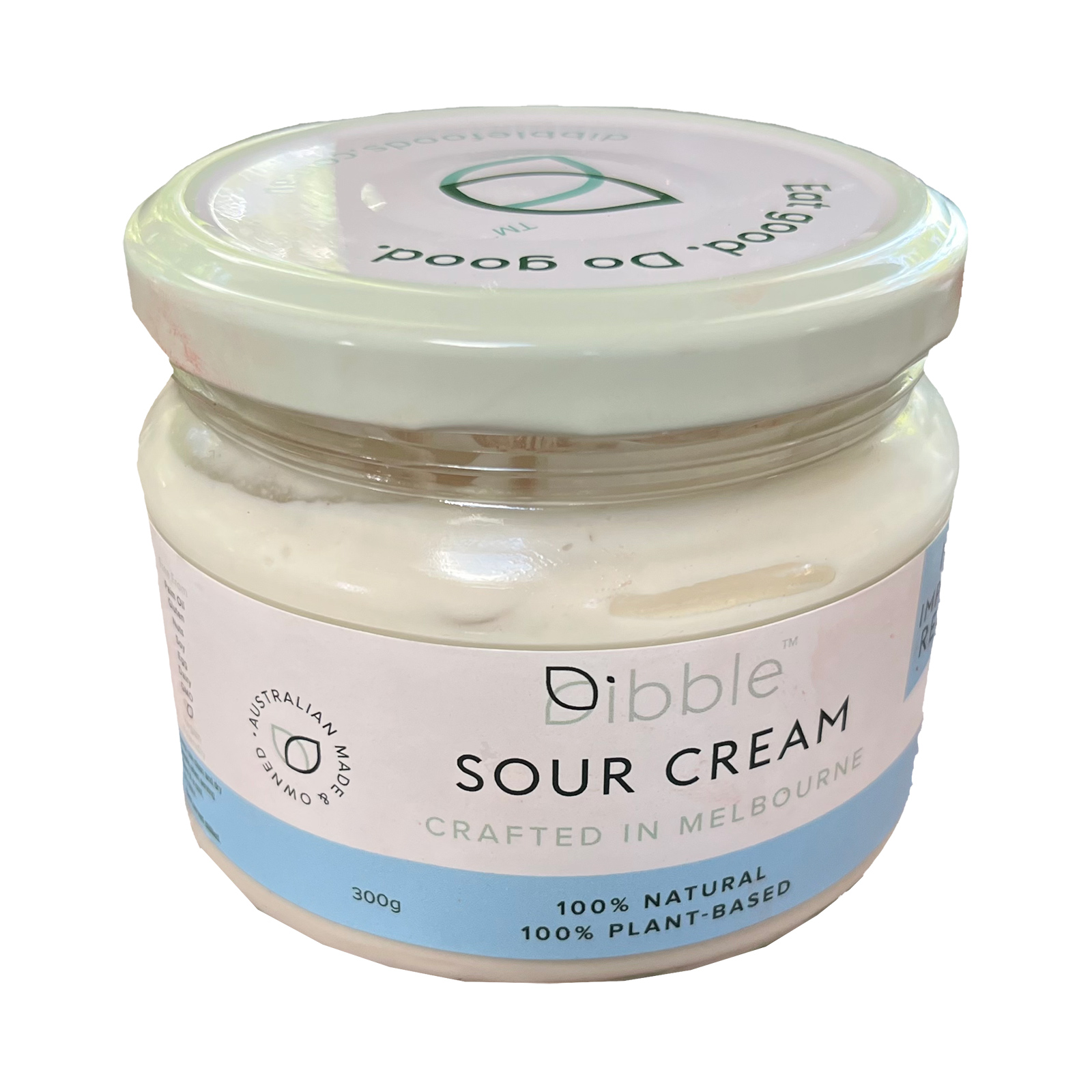
New to my world is the Dibble brand which is out of Melbourne. It is presumably a niche brand as I have only seen it at a Foodland here in Adelaide which I know specialises in a larger variety of vegan smallgoods. Having tried a few dodgy sour cream attempts, I am always wary of wasting my hard-earned $$ on a big fat disappointment, but Dibble thankfully came through with the goods! Their jar says “New improved recipe” and what I noticed with online reviews of their first version was that people had a problem with their faba bean ingredient giving an unpleasant texture (we’ll talk to you in a sec, Made With Plants). What they do very well in this incarnation is to ditch the faba bean and introduce pea protein and natural gum guar, the latter of which the Tofutti uses. While having a very different texture to the Tofutti, it has a firmer almost “whipped” texture which is quite appealing (though I suppose, not technically identical to dairy sour cream). Where Dibble really shines is coming up with an excellent balance between the tart and the creamy. I personally don’t like it too tart but I still do want it there.

The Made With Plants grew on me in the sense that it smells and has the tangy taste of a dairy-cultured cream which is possibly the most accurate of this group to its dairy counterpart. Whether that is what you want is another thing. I find it almost a bit too sour as if it is going off slightly. What I didn’t care for was the runny “thickened cream” texture nor the distinct faba bean “after-tongue”. Yes, I think I made up a word there. You’ll know if you try it: you have a bite, swallow and then are left with a weird “glaze” on your tongue which is not too pleasant in my opinion. I definitely think it’s the faba bean though it could be one of the thickeners.

The Tofutti is a very different beast. The texture is a clearly firmer than dairy sour cream or the others here, but if you stir it, it whips up into a super-smooth confection. Its versatility comes in that it is not too sour but enough so in a subtle and accurate way to be definitively sour cream so it can be blobbed on top of nachos, or stirred into a mushroom stroganoff or just anything needing a sort of neutral thick and creamy stir-in. On it’s own it is also very good, though you start tasting that it’s not quite the same as the dairy version; however, I don’t recall ever eating sour cream straight from the tub anyway.

The verdict is a close-call: I love the ease and versatility of the Tofutti, but the Dibble was an appealing balance of all sour cream attributes. It’s also cheaper than the Tofutti which is a US import, so definitely adds to the costs a bit due to that. Made With Plants sadly isn’t really a contender with the other two according to my palette, but it is quite sour if you like that sort of aspect of a sour cream. The tongue glaze knocked it down a notch for me though.


Thanks for reading! Let me know what your favourite sour cream is so I can check it out or review it. What do you love about it? Do you disagree with my assessments? Let’s fight! 🤣 No, I’d love to know as we all have different tastebuds 😁

Vegan foods reviewed – part 6 (USA edition)

I recently came back from LA due to some family responsibilities and while I didn’t get much time to explore the full gamut of vegan offerings while there, I did make sure to try some new stuff at the grocery stores.

If you’ve tried and loved Follow Your Heart products, I was delighted to find that they started as a restaurant/store decades ago and that place happened to be near where I was staying. (This was more of an anecdote because I was excited to visit their awesome restaurant…I’m not reviewing their food this time around! 😛)

This entire aisle is vegan food; a mind-boggling vista if you’ve ever been to a normal grocery store!

Anyway, today we have some fun offerings from Daiya, Clean South, Sweet Earth and So Delicious.

These reviews are particularly geared towards former omni eaters who are keen to have that meat or dairy favourite available as a tasty cruelty-free equivalent.

About the ratings system: Ratings are for what I consider the important elements of an appealing food product, with “Texture” being one that you might not normally see for other food reviews, but to me it is quite indicative of the success of a meat or dairy substitute. I choose “Value” over “Price” as vegan foods are generally more expensive than their meat or dairy counterparts (or rather, the latter are unreasonably and irrationally cheap given what they are) so I choose to focus on how good they are for the amount you pay.

On to today’s reviews:


PRODUCT: CLEAN SOUTH – VEGAN BUFFALO WINGS
Type: Prepared meal
Country of origin: USA
Clean South


clean south wings

Whenever I see things with “buffalo” flavouring, my mouth instantly starts to water. Back when I had an omnivore diet, hot chicken wings were my guilty pleasure. While I now think about how abhorrent it is to consume the little wings of young chickens, the desire for that flavour doesn’t leave you and I am forever on a search for the perfect buffalo wing replacement. Enter: Clean South’s Vegan Buffalo Wings.

I am not prone to using OMG to describe foods, but O.M.G. these were good. I honestly couldn’t even be bothered heating them for the first half of the box, but then when I did and paired them with Daiya’s dairy-free blue cheese dressing, flipping’ ‘eck bro, things got crazy-good. Now, in restaurants I have tasted some darned good vegan ‘wings’ but this was the first packaged ones I’ve had that just nailed it. Texture, chewiness, beautiful tangy and hot sauce (and plenty of sauce), tasty and addictive. I’m a big fan of Franks’ Red Hot sauce inspired hot wings sauce, so this was just right for me.

Being that I was in the US and this was a local LA product, I kind of expect things to be a wee bit cheaper, but no, these were quite expensive at US$9. I’m happy to support a local, small producer that is banging out awesome food though. I desperately wish I could get these in Australia, but I’m also glad I can’t get them too easily as I’d be broke 😅


More to come….


Vegan foods reviewed – part 4

I’m excited to be getting back into reviewing products, especially now that there are both so many new foods to try but also so many new vegans every day choosing a cruelty-free life! To those who might be reading, kudos to you! Even though longer-time vegans are generally good at scouring the shelves and internet for any new products, I thought I’d put my 2 cents in as well since it’s harder to find groupings of reviews in one place. Eventually I hope to make it a separate and searchable area, with links to products.

vegan-symbol

These reviews are particularly geared towards former omni eaters who are keen to have that meat or dairy favourite available as a tasty cruelty-free equivalent.

Ratings are for what I consider the important elements of an appealing food product, with “Texture” being one that you might not normally see for other food reviews, but to me it is quite indicative of the success of a meat or dairy substitute. I choose “Value” over “Price” as vegan foods are generally more expensive than their meat or dairy counterparts (or rather, the latter are unreasonably and irrationally cheap given what they are) so I choose to focus on how good they are for the amount you pay.

On to today’s reviews:


PRODUCT: FIFYA – KALE, ROCKET & WHITE BEAN DIP
Type: Snack food
Country of origin: Australia
Quality Food World

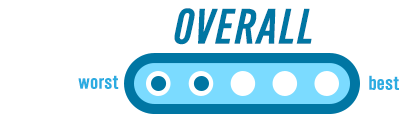
overall-5
flavourrating-5
texturerating-5
valuerating-3

2505264-fifya-vegan-dips-kale-rocket-white-bean-250g-web
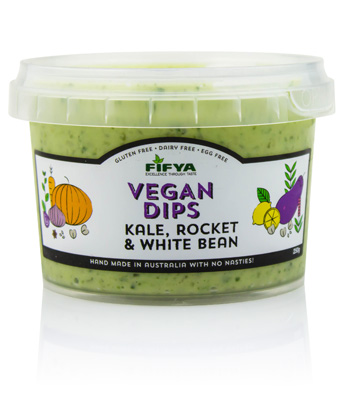
The title of this dip isn’t the most enticing you’ll come across as, on their own, none of these things are that mouth-watering items of desire. However, the way that FIFYA has combined them where the white bean becomes the creamy binding element giving it a smooth texture and the spiciness of rocket and the other flavours like pumpkin seeds, lemon juice, apple cider vinegar and olive oil round out the dip in a very appealing way.

FIFYA does a variety of vegan, gluten free, preservative free dips like roasted eggplant & parsley, pumpkin & roast capsicum plus sweet potato to name a few. I intend to try them all in due time and I’m not sure how I came to try the kale one before these more obvious  choices with “roasted” veggies (my fave) given that kale is low on my veggie list (not my fave). I’m glad it happened though, as it is a satisfying dip for snacking.

The most impressive part of this dip is the flavour which is punchy and a nice balance of savoury elements, and is perfect on crackers, pita or with fresh cut veg. The texture is smooth and good, although perhaps a bit runny and lumpy as far as dips go, but it’s not a big issue. The dips represent ok value; I am not sure if it is because they are a smaller company or if by adding “vegan” onto something they can charge more, but at $2 per container more than most of their competition for ingredients that are far from exotic, $5.50 is a bit high to pay for a 250g dip. Being 100% vegan, I will reach for it if I’m tiring of hummus but I would buy even more often if it were a bit lower in cost.


PRODUCT: CHICKPEA AND CAULIFLOWER MASALA BURGER
Type: Burger patty
Country of origin: New Zealand
Bean Supreme

overall-5
flavourrating-5
texturerating-5
valuerating-4

masala-burger-packaging

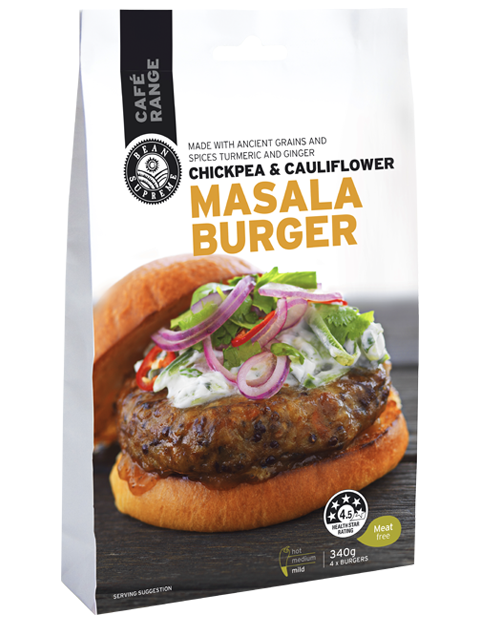
On first viewing of these Bean Supreme products, I find the packaging quite appealing: clean, modern and super-tasty looking food. I would be very surprised if a meat-eater would look at that image and not be seduced into trying it.

That does happen a lot with vegan foods I suspect, but the trouble is that the flavour doesn’t always match the what the image is selling. Unfortunately, even with vegans – most of whom started out as meat and dairy eaters – there is an expectation that certain foods that look a particular way will taste how we have become accustomed to them tasting. I pity the vegan product-makers who create foods with amazing flavours but someone who has a preconception might reject it simply because it doesn’t precisely match what they were expecting. Anyway, I digress…

What does that all mean with regards to Bean Supreme’s Masala Burger? Well, unfortunately the image oversells the product by a fair amount. When I first saw the raw patties, I was reminded of the ABC show The Checkout which has a segment that displays a product’s marketing photo vs what it really looks like. This was kind of the same: the patties were yellow and thinner with speckles like seeded mustard. Still, I hoped for the best and thought that as they browned they would look like the photo.

I baked them as it suggested that was a “healthier” way to prepare them, but when I took them from the oven they looked a bit anaemic, so I gave them a fast fry to brown them up. They looked better but were very dense and fairly dry compared to the juicy-looking photo. This is one of those cases where a beefy looking image was a omnivore’s nightmare, with a very-beany patty with blandish flavour. I didn’t get a sense of the intended “fragrant Indian spices” and it even was hard to dress up with some bbq sauce which I resorted to in the end.

At $8.60 for 4 patties, they weren’t the most expensive patties but they also were not that cheap, and given the competition in this category, I’d likely opt for something else before having these again.


PRODUCT: VEGANAISE
Type: No-egg mayonaise
Country of origin: USA
Follow Your Heart

overall-4
flavourrating-4
texturerating-5
valuerating-4
Organic-vegenaiseThis item has been around for awhile so it’s far from revolutionary, but it continues to be a shining example of how a vegan product can so effectively eclipse the item it is emulating.
Follow Your Heart has a lovely backstory of four vegetarian friends getting together 40 years ago to do a business that followed their ideals. You can see that there is a lot of love and successful tinkering in this product as I would say it is near-perfect. When I was an egg-eater 6+ years ago, creamy mayo had me hooked…I didn’t care for the low-quality stuff and ones that had a funny texture that was “slippery” and broke apart (like Hellmann’s) but rather liked Thomy’s very creamy and flavourful type. Vegenaise finds a good place in between flavour and texture-wise so it is as appealing as a spread as it is as a dip (the latter of which I am guilty of using it more often than anything else!).

I haven’t tried the organic version side-by-side with the regular version, so I don’t know if there is a real taste difference. I also love the garlic version which is much more aioli-like but not overly garlicky. Their byline is “better than mayo” and while I’d say that it is “as good as high-quality egg mayo” in terms of taste, the fact that it is eggless makes it far, far better.

The only thing that knocks down my score in terms of value is that I still don’t understand why there is a mark-up on vegan products when they contain no exotic ingredients (you’ll hear me harp on about this a lot 😝). At $9 per 473ml jar, it comes in 50% more expensive than gourmet egg mayos and twice as much as “regular” egg mayos. Even taking into consideration industry subsidies and economies of scale, I still think it is unnecessary to charge so much. If Follow Your Heart has been around for 40 years, they shouldn’t be considered a boutique brand anymore either.

Price rant aside, it’s one of my favourite daily-use products!


Have yourself an ethical little Christmas…

As Christmas approaches, I am feeling very passionate about reducing the amount of cruelty-created products in my life and the lives around me, so I’m hoping you’ll take a PLEDGE to try to do this yourself this season.

Christmas represents a time when people gather for meals, share gifts and eat too much chocolate. All I am hoping is that you’ll consider reducing your intake of animal products and if you do, then source Fair Trade or ethical/humane options (see options below). And with the gifts you purchase, please consider where it came from and reduce the likelihood that it was procured using slave labour.

Some suggestions:

— chocolate: please avoid milk chocolate as the milk comes from antibiotic-filled, tortured animals. Especially the cheaper chocolate which will also be using cocoa beans picked by slave labour. With cheap chocolate, you are usually also supporting a multinational company that cares nothing about welfare and only about bottom-line earnings. Aim for dark chocolate with the Fair Trade logo on it http://fairtrade.com.au/  If you think you can’t afford to pay a bit more, chances are you should just save your money altogether and not buy ANY chocolate as neither you, nor the planet, can afford the cost of this luxury!

— meat: try to find alternative options to meat altogether. With everyone ramping up with their traditional of consuming a bounty of meat they usually eat this time of year, the number of animals slaughtered reaches an epic and horrifying high (Kill Counter: the moment you open the following web page, it tells you how many creatures have been killed from that moment on to deliver you the range of foods that humans have come to expect. I challenge you to watch it for 1 minute and then honestly assess how you feel about the totals you see: http://www.adaptt.org/killcounter.html )

If you MUST have some meat, please don’t buy the cheapest cuts which will definitely come from abusive factories. It’s not just how MANY animals are consumed, it’s how miserable they lived their lives. Why would you want to eat something that was terrified, miserable, orphaned and murdered? Look at the Humane Choice website ( http://www.humanechoice.com.au/ ) as an example of where to get ethical meat and eggs. Remember: every creature on this planet has the SAME RIGHT to be on this planet as YOU DO.

— consumer products: here’s a great guide to why it’s important and what/where you can buy to ensure a better chance that you’ll be getting stuff not made by slaves: http://www.ethical.org.au/consumer/christmas/christmas-gifts.htm There are also lots of charitable organisations like TEAR’s Useful Gift catalogue ( http://www.usefulgifts.org/ ) where you get to give something that actually helps someone else in a life-changing kind of way. It is after all the season for GIVING, right? 🙂

I try to live by these examples but none of us are perfect. However, if we all pledge to try to eat 50% less dairy, 50% less meat and be wary of where are other ‘stuff’ is coming from, that will already represent a positive change.

Will you take this pledge?

Lifestyle Report – as of Nov 2013

This is my fourth Report (usually once/twice a year) as a way of assessing my successes, targets, improvements and areas I need to be more vigilant with when it comes to simple, ethical, environmentally sustainable and community living.

It might not be an interesting entry to read but it’s a way to keep myself accountable and constantly improving my lifestyle.

I’ve highlighted positive changes in green and backwards steps red. So, as of today:

ETHICAL/SUSTAINABLE LIVING

• grocery shopping (with % of how often I do it)
— observing a vegan lifestyle (due to my work and my beliefs, I allow myself some leeway but am committed to greatly reducing or eliminating meat and dairy everywhere possible (90%)
— local green grocer for veg (75%)
— leftover bread free at end of baker business day (0% – though eating less bread in general);
— skip-dipping/dumpster diving (0% – slack but they are hard to find and I’m not really looking)
— major supermarket for all else (20% – Coles/Woolies, 70% – Foodland (local);
— Fair Trade where possible (tea, chocolate, recent clothing)
— organic where possible/affordable (25% – food, soap & shampoo)
— use Ethical Guide to boycott bad companies (50% – need more vigilance here);
— boycott GMO foods (70% where possible)
— boycott food with known cruel processes (90% where known)
— food miles, locally produced (50%)
— meat consumption (0% of meals)
— dairy consumption (5-10%)
— toilet paper from Who Gives A Crap (50% of proceeds go to developing countries with poor sanitation to help built toilets) (100%)

• grow own food (10% – tomatoes, eggplant, herbs)

• household shopping: I only buy new from store if I can’t get from op shop or build myself;
— purchased new in past year:
—– furniture (0%)
—– clothes (10%)
—–accessories (15%)
—– car (0%)

• home energy:
— electricity:
—– solar/renewable = no
—– aircon/heating (15%)
—– computer (off at night)
—– fridge (2/5 star rating)
—– dryer (0%);
— water:
—– rainwater tank (0% – no longer have one)
—– grey water for garden (15% – washing machine only)
—– shower avg. duration (5 mins)
—– garden (10%)
—– dishwasher (0%)
—– washing machine (top loader 2/5 star rating)

• waste:
— food scraps (100% goes to compost);
— wasted food (5%);
— recyclables like glass, paper, aluminium cans (95% to recycle bin, 5% kept for food/household storage);
— wasted paper (minimal use of printer, kitchen & recycled toilet paper)
— wood (90% saved for building material); haven’t built much now that I have what I need!
— white goods, electronics, equipment (0%)

Areas to Improve: fewer food miles; support local; buy organic if it makes sense & affordable; grow more of our own food; continue to consume less energy & town water. As it gets hotter, it is tempting to use aircon but we generally don’t succumb until about 35 degrees or more.

.

– – – – – – – – – – – – – – – – – – – – – – – – –

.

SIMPLE LIVING
• build most of my own furniture (lounge daybeds, coffee table, office desk, outdoor tables & seats)
• other furnishings have been donated (bed, futon, tv & DVD) or secondhand (kitchen table & chairs, office chair, rug);
• buy nothing that isn’t essential to the household or work
• work less, spend more time connecting with friends & family; (has been a very busy past 3 years. Trying to find that work-life balance again)
• spend money on essentials, friends, charities;

Areas to Improve: connect more with real (not virtual) people

.

– – – – – – – – – – – – – – – – – – – – – – – – –

.

ENVIRONMENTAL
• approx. annual carbon footprint (avg. based on lifestyle as of today): 4.5 tonnes of CO2 (Aus avg. 16 tonnes; world avg. 4 tonnes). This is not including my poor flight behavior below 😦
• car usage per month – approx 400kms ; mileage (approx 10kms/L)
• bus instead of drive (20%)
• ride/walk/skate instead of motor transport (10% – 15min walk to shops)
• return flights in past year – domestic (2), international (2); Unfortunately, the past couple of years have been baaad. This year was a flight for personal and one trip for business.

Areas to Improve: take fewer flights; walk/skate/bus more rather than car; use less electricity; aim for 4 tonnes/yr CO2 including travel

.

– – – – – – – – – – – – – – – – – – – – – – – – –

.

COMMUNITY
• I now live with my wife so no more commuting to see one another; most friends are the same distance or closer now though
• intentional community living (share house or close living) = no
• share property or resources with community (some household items, driving, food with my wife’s best friend; borrow from other friends occasionally)
• collect hard rubbish from neighbourhood
• engage in conversation or help with mentally/physically challenged people in neighbourhood (0%)
• give to charities (monthly to: 3 x global aid, 2 x animal, 2 x activism organisation, 1 x community fund )
• volunteer with some friends’ and charitable projects
• community gatherings for shared weekly meals and social activities

Areas to Improve: aim to achieve closer and more intentional community; share more resources; be more accepting of minority/disadvantaged; give more to charities; get more involved with meaningful & helpful projects

NOV 2013 SUMMARY: overall, doing the right things still but still not socialising much due to workload. Some areas I can still be a bit more green. Would love to get more friends to jump onboard different aspects of sustainable, ethical or green living but am still trying to take the approach of “be the change you want to see in the world” however it is not always easy not to promote/preach, be judgmental or not be hypocritical. Involving myself in a great deal more research, protests and campaigns and becoming more politically aware. Taking a strong stance against animal cruelty and using social media to regularly drop hints to friends/the public. Trying not to become overwhelmed or too despondent about the current state of the world and others’ apathy to change!

Don’t label me, please

Since assuming a vegan lifestyle and an ethical stance against animal cruelty, I’ve heard a couple of stories from friends about the strict labelling that comes with being vegan. By that I mean the term “vegan” seems to attract some sort of expectation of behaviour that is not applied to any non-vegans. I heard the second story tonight and it seemed directed at me, and it made me angry…thus this slight rant.

In the two stories I’ve heard, one couple were self-enforcing the vegan label so vigorously that they would call out anyone who didn’t strictly adhere to veganism and would feel it a personal failure to step outside that realm themselves. In the story I heard tonight, it came from the other side of the coin; a non-vegan who was ready to challenge my use of the “vegan” term as I have indicated that I intend on living a 90-95% vegan lifestyle because I don’t want to become one of those people who make life difficult for others because of the lifestyle I am adhering to. Also because I want to be realistic.

I probably didn’t make that clear to the second friend when I started a vegan lifestyle because — I imagine like most born-again-vegans — we make a sudden thrust into the vegan world for either moral/ethical, health, environmental or animal rights reasons (or some or all of the above) and so we immediately gravitate strongly to the “vegan” label. To be fair, it’s initially empowering to call ourselves that, to clearly differentiate ourselves from the animal-murdering masses.

For the record, these are the terms of my vegan lifestyle:

  • On a daily basis, I will refuse to consume dairy, meat, fish, or things containing these items.
  • If at a friend’s home, I will shift to vegetarian eating if that is all that is available and let them know I eat vegan for future reference.
  • I eat eggs that I know are from cruelty-free sources, like friends’ chooks or a certified humane farm. I am very strict about the living conditions for the chickens.
  • I will refuse where practical and possible to buy items using animal hides, like leather. I will never buy fur (besides, it’s just so last season! 😛 ). I might buy a second-hand leather item as the deed has been done and I don’t believe the wearing/using these items incriminates me because it looks like I’m supporting this industry
  • I actively support animal rights through charitable donation, researching and sharing information, plus joining activist rallies like Ban Live Export.
  • I am adamant about protecting the environment by fighting for a reduction of factory farming and changing agriculture practices.
  • However, I respect the traditional hunting practices of people who live far in the bush or like the Inuit people who take only what they need to personally survive and who ritualistically cleanse the animal when they kill it, respecting the life they are taking.
  • I actively take care in knowing which companies do animal testing on their products and then boycott that product if they are animal abusers.
  • I plan to work more directly with protecting animals in the near future

With all these things, I aim for a 90-95% success rate as I believe that we have to be realistic: while I want animal suffering to cease, I recognise that a vast reduction would be considered a “win”. We cannot change this world 100%…it is impossible. And perhaps we don’t need to either.

For all intents and purposes, I am quite comfortable working within these boundaries and still consider myself following a vegan lifestyle. What’s more (and perhaps more importantly), I don’t care if I’m not living up to someone else’s labelling (and therefore their judgement). Another person I know heard that I was eating eggs (even with my strict policy for choosing them) and announced “so I guess you’re just a vegetarian then” as if I didn’t meet the vegan standards and was therefore stripped of my title.

I must admit it makes me laugh when I hear someone judging me for attempting to live a very challenging lifestyle, one that has health and ethics at its core, but where I am perhaps not living up to the dictionary definition of it. And by “makes me laugh” I mean I want to beat them with a hypocrisy stick. There is not one single way a meat-eater can make a judgement on the effectiveness or competency of someone who is working hard at their vegan lifestyle without sounding like a complete tool. That’s why I really dislike the label; it’s too easy for people to want to score you on how you’re doing with it.

I know this is sounding a bit like a rant but my wish is simply this: if you know someone trying to follow a vegan lifestyle, please support what they are doing even if it isn’t what you personally want to do in your own life. No one is judging your meat-eating ways even though the destructive nature of meat and dairy consumption gives vegans a lot of ammunition to fire at you.

If you are a vegan, my hope would be that you can see that we live in an imperfect world and we need to do our best but not beat ourselves up (or others) who aren’t perfect vegans all of the time. Plus, we need to gently inform meat-eaters of why it might not be a bad idea to cut back on their consumption, for the better of the planet and the rest of us who must deal with the fact that agriculture is destroying it. In other words, no one should judge anyone else, but we should all be prepared to listen and adapt for the better of our lifestyles, needs and the world around us.

Let’s not be so fussy with our labelling of each other!

🙂

P.S. There is a lot of self-righteousness that comes with our choices, particularly food ones. My wish would be that everyone be open to arguments on both sides of the meat/vegan debate, concede when someone has a valid point on either side, and stop letting personal pride dictate how “right” you think you are about following what you believe. Let’s all just try to make informed decisions and then we might see that personal labels are pointless anyway.

Cow’s milk (bovine breast-milk): the Great Debate

cowI was recently reading a blog posting about dairy on the controversial and very outspoken blog called the Collective Evolution. I’ve been meaning to post something about this topic as well as I feel strongly about it from an animal cruelty point-of-view but the more I learn about the health implications, the more surprised I am how many people continue to consume it. Even more surprisingly is how many people defend their dairy consumption, but then again, I guess it’s like the meat debate; you’ll always have people steadfastly defending the perceived merits from both sides.

The thing with dairy though is that much of it comes from factory-farmed sources, and while you can argue a case for grain-fed raw unpasteurised milk being better for you, the vast majority of people eat dairy tainted with chemicals, hormones, antibiotics and unsavory other bits, then forcibly over-milked from suffering, unhappy animals. That stuff on most supermarket shelves is arguably the most processed, unhealthy, tainted and cruel beverage you can buy.

There is much I could say in my own words about this issue, but the following excerpt I found was in the comments section on the Collective Evolution article amidst heavy debating on this topic. This particular excerpt stood out due to the writer’s calm logic – a logic with which I completely agree. So to save just repeating what is already a well-written argument, I will add her words here. Unfortunately I don’t have a full name to give credit but I’m sure the writer in question would be happy for more people to hear what she has to say…

This informative piece is from poster “Karen” (22 May 2013)

Every drop of cow’s milk in any cow’s milk product represents a baby that is not getting the milk designed for him or her.

Male calves are taken from their mothers within 12-24 hours after birth, fed a low iron diet and kept mostly all indoors in the hutch in order to induce anemia (for the most pale, tender flesh), and with a bottle of milk not superior to its own mother’s milk, so that the milk intended for it does not go to to the calf, but to humans it was never created for. The only reason the farmer lets the cow suckle for the first few days is to get the milk flowing after colostrum, just like in humans, and then the baby and mother never see each other again.

On the other hand, If nature were allowed to take its course, the calf would breast feed for up to a year (which is about the same time many humans choose to stop.).

In order for that hypothetical cow’s mother to be pregnant, it had to be Artificially Inseminated on what is called a “rape rack”.

The Artificial Insemination process is an element the dairy industry does not advertise when selling their products: a farmer sticking his entire arm up the colon of the cow to his elbow in order to manipulate the cervix and shove a long steel device containing a long needle syringe of semen into the vagina and through the uterine wall. He masturbated the male to climax (Webster’s dictionary definition of Bestiality). This is done to the female as soon as she is possibly able to conceive (imagine in human years what this would mean: it is the equivalent of 10-12 year old pregnant human girls.).

The farmers keep the cows constantly impregnated throughout their lives, starting as young as they can possibly become pregnant, and each time they give birth after gestation period of 9 months (the same amount of time it takes for a human mom to develop a baby), they are impregnated again 3 weeks later, until they are no longer producing milk at the same rate as their younger sisters, at which point they are slaughtered: every female cow still lactating from the nipples as it hits the slaughterhouse floor.

There is no magic cow that magically makes extra milk for humans. Like humans, they must first give birth.

These are what the hutches look like in reality: http://www.facebook.com/photo.php?fbid=422882381091565&set=a.422499237796546.91761.422224324490704&type=1&theater

Farmers don’t allow the babies to drink the milk (except to suckle for the first few days of their life. That baby can not be called “breast fed”, anymore than you can say a human baby who suckled for colostrum only the first 2 days of its life was “breastfed”).

The next time a farm tells you they allow their male calves to breast feed, be sure and ask: “for how long?” Because stated one more time: they only allow the baby to suckle for the first few days in order to get the flow of milk started, contrary to the feigned pretense that they are actually breastfeeding, or that they are doing it for the baby’s health. They are in the industry as a business and it is not profitable for a baby to cut into those profits by drinking the milk the mother made for it.

The milk that they normally make for their calves would in no way cause their udders to become engorged were they not mechanically suctioned on average of only twice a day, making it very painful for the cow to the point where she is unable to stand from the weight–she would have to be milked and must return for it: this pain is induced and would not occur in nature were she just feeding her calf. (So the whole lie we’re brought up with that “cows need to be milked because otherwise it hurts them! They like being milked, because they walk right in to be milked!” is exposed for why that is. You don’t make the problem and then claim to be the hero for “saving the day”.).

Were you undergoing the same pain from this overfullness of milk, (since they are induced to create 35-50 litres of milk per day (about 13 gallons), which is more than 10 times what they would normally be making for their baby calf), you would want relief too.

The veal industry is a direct by-product of the cow’s breast secretions industry and is inseparable.

The male babies are disposed of in one way or another (either shot within hours of birth, a hammer taken to the head, or raised in a short, miserable few weeks of life away from their mothers to be slaughtered as veal), because they are of no use to the industry, just like male chicks are ground up alive in mechanical macerators, gassed, or suffocated in bags after hatching. The females follow the same slave footsteps as the mother until they too, reach the same death end.

If what happened to female cows happened to female humans, there is no doubt in anyone’s mind that it would be called rape: they are forced into pregnancy without choice of partner, or choice of when they want to be pregnant, or if they want to be pregnant at all, all so that humans can take and murder the baby for the breast secretions, hook them up to machines in spaces that make them stand until 40% of all female cows are too lame to walk at a pre-determined “slaughterhouse time” and must be dragged by chain across the floor.

The cows watch in complete terror as relatives and people of their social hierarchy in front of them are raised by the foot on a conveyor belt or taken a bolt gun to the head, and have their throats slit, sometimes still conscious and kicking, and shred of their parts within seconds after murder, with no choice to go anywhere but to the same fate forced upon them. The screams of slaughterhouses, the stench, the run-off–it is horrendous.

As a mother, I dreamt of this before I went Vegan, of what it would be like to be a female cow on this planet. And it was a nightmare, more hellish than anything I could possibly imagine. I knew there was no other word for the actions perpetrated on this species than evil.

The tipping point that turned me Vegan: a photo entitled “milk by-products”–a pile of dead newborn calves, shot and piled on top of each other, in a bin, view angled from the top of the bin. They look like baby deer. Then I discovered there is no worse sound than a mother who has been separated from her baby, who will bellow frantically for days, or a baby from the mother.

If given the option, mother cows and their offspring would stay together for life.

On a happier note, a video of a sanctuary who rescued a separated mother and brought the calf back to return:

http://www.godvine.com/Cow-Cries-All-Night-Over-Loss-of-her-Calf-Then-They-Reunite-1903.html

All cows, unless rescued by someone who cares an awful lot, and raised in a non-profit sanctuary, are being killed so someone can have their hamburgers of their bodies and then wash it down with milkshakes of their own secretions.

There are no more wild cattle (except in very tiny amount as endangered species) in any areas of the world because of the tyranny of some humans. This is not an exaggeration.

But if there were, the cattle prefer living in mountain forests–not flat, dry, void, grassland. They can live anywhere from 25-35 years old in the wild. As business commodities for profit, the dairy cows are slaughtered on average between 2-4 years old.

De-horning (the equivalent of breaking our bones), tail docking, third degree burn branding, and burning the tissue (also third degree burns) from their heads where the horns would normally grow so the horns won’t grow in can in no way be called “natural”, so why do people who drink cow’s breast secretions say these standard “requirements” are a natural thing to do?

There are no U.S. laws that give rights to “humane” treatment of farm animals (as long as the businesses get together and decide to do a practice, no matter what that practice is, it is upheld as “industry standard”), none enforcing transportation standards, which result in deaths, sicknesses and injuries. Here are a few research websites:

http://nzdairy.webs.com/thelifeofadairycow.htm

Here’s many different diseases indicted with consuming cow’s milk:

http://www.notmilk.com

This powerful study shows the blood of those on a Vegan diet is 8 times better at both slowing the growth rate of cancer cells and stopping it in its tracks. Check out the results of only 2 weeks on a Vegan diet on breast cancer cells.

http://www.youtube.com/watch?v=xTIrmOdmil4

“20 experts on the breast cancer and dairy connection”:
http://freefromharm.org/health-nutrition/21-experts-on-the-dairy-breast-cancer-connection/

What’s in a glass of cow’s milk?

Answer: blood, pus, +80 hormones (including from cows not injected with rBGH), lactose, which our bodies CAN NOT process, so lactase is artificially added (because the meat and dairy industries know what’s best for us, right?), casein (which our bodies can not use & is indicted with many forms of cancer), long-chain saturated fatty acids which do not flush out of the body (unlike the medium-chain length from plant sources such as avocado & coconut), cholesterol, acidic protein which leaches calcium from bones, dioxins, dead bacteria from pasteurization, pesticides, herbicides, and antibiotics. Cow’s milk is a mucus and acne producer.

Cow’s milk has an opiate effect on the brain, has been indicted with Diabetes T1 & 2, osteoporosis, arthritis, breast, colorectal, ovarian, kidney and prostate cancer, gallstones, Alzheimer’s, anemia, autism, allergies, asthma, constipation, headaches, obesity, and more.

There is no such thing as humane dairy. With every drop of dairy, rape occurs, a baby is stolen and a murder happens. And all for a product that kills us inevitably, leads to disease outbreaks and environmental destruction, and that we don’t need.

The testimony of a worker who was in charge of separating the mothers from their babies and ensuring the babies accept the substitute powdered water “milk”:

http://motherhooddeleted.blogspot.com/2008/11/crying-of-mothers.html

I could go all night into the environmental and humanitarian consequences, so I’ll save that arena for another time.


My hope – as it is with eating animal flesh – is that while I can’t expect people to completely give up dairy or expect the industry to just pack up and stop, we CAN greatly reduce our consumption to the point that factory dairies can be a thing of the past. My hope is that everyone can consider with compassion the plight of these animals and simply reduce their dairy intake, encouraging others to do the same. At the very least, pay that tiny bit extra to get your milk and eggs, etc. from a humane source.

If anyone decides the want to flame on at me on this topic, please read the whole blog posting first and consider the core argument here: animal welfare in factory dairy farms. Alright; off you go then…

Striking a balance: what kind of vegan to be?

Oddly enough, one of the things I’m struggling with becoming vegan is how to act in my daily life. It is something I’ve been having a tough time with even in terms of writing this blog, thus the reason why I have gone quiet of late. Should I be the dedicated preacher? The informed educator? The impassioned extremist? Quiet and tolerant, doing my own thing? Perhaps none and all of the above…

When I was first smashed over the head with the waves of passion that prompted me to give up meat and stand up against animal cruelty, I went all-in, guns a-blazing, making sure everyone heard what I was doing, all in the vain and naive attempt to get people to “convert” right along with me. My blog was an excellent platform, I told myself, to ensure that people knew not only how I was feeling, but the depths of the atrocities that occur (in full, living, bleeding colour). Surely if I posted enough informative and eye-opening material, if would be a no-brainer to get everyone on-side with this important task of ditching their traditional habits and embrace a new, healthy and compassionate way of living. Right?

Well, I pride myself on being reasonably observant and respectful of where people are at and while I was initially overly gung-ho, I’ve quickly realised that I need to take this much slower. While I am still madly passionate on this topic on the inside, I’ll have to squeeze out my information-sharing in controlled doses, letting my conviction and own experiences try to let others see how where I’m coming from can be doable to them over time if they believe it is right for them as well. Another thing I need to realise is that people are repelled to change by people who are in their face about it, pushing too hard or being “forced” to learn a new perspective, especially with a subject as touchy as food. Finally, being tolerant or where others are at and non-judgemental of their actions even if I don’t believe what they are doing is right, by my standards.

So what kind of vegan do I want to be? I obviously want to be faithful to my reasons for doing it in the first place (compassion for animals, environmental concerns, and personal health); I want people close to me to understand and respect what I am doing but also be willing to be open to listening and learning and changing as well; I’d like to be proud of what I’m doing and therefore promote it in a confident but dignified and democratic way; and I’d like to be someone who goes beyond just eating differently but also volunteers or involves myself directly in the helping of rescued animals or protecting environments where animals are at risk of losing their rights or lives.

This blog will continue to be my voice to show my personal progress on my journey and try to provide information that people I know will hopefully occasionally read/watch and be involved as well.

I’ve struggled a lot with casting judgement on people who refuse to change their habits when they know how much damage those habits are contributing to the issue of high-production animal-based agriculture, but I am learning that traditions and habits are often hard-wired into who we are from an early age. From influential parents, peers, expectations, plus media and advertising, we are told many things that are actually false or have critical information buried from view to make us think things are different than what they are. However, I cannot condemn people who have this hard-wiring anymore than I could be angry with myself as for all my 42 years until now, as I believed the exact same things and was victim to the same propaganda.

The following video that I came across recently is an excellent resource for anyone who has either flirted with the idea of going vegetarian or vegan, is curious about the idea or is starting to feel that there is something seriously wrong with our meat-eating society and wants to learn more. Intended for high school students originally, this brilliant talk eases you into the logic behind “going vegan” without being too aggressive with scary visuals. Basically the ABCs of how we’ve been conned into thinking we want and need meat.

I naturally believe that this sort of video is mandatory viewing for any and everyone, but I suspect a very small number of people will take the plunge. If you are willing to have your eyes opened and allow yourself to engage in a very important message, then you will be very thankful you did….!

I believe that resources like this will help people expand their vision on what being a vegan is all about without them all coming from me. There is a wealth of influential material out there that I hope to share and all I ask that you respect why I am offering it up and have a willingness to give it some consideration.

http://youtu.be/9TlHcEcUWUE

UN Report “Livestock’s Long Shadow” eyes a dark future

FAO-emblem_en(EDITED: I received an interesting anonymous communiqué indicating that some of the info in this UN Report is actually underselling the problem in some regards plus actually encouraging action that is contrary to what I would expect to hear after reading the introduction to the Report. I’ve added some notes below based on what I have learned.)

It is probably well worth reading the whole report, but I’ve included a link to the introduction of UN’s 2006 report regarding the incredible and increasingly insurmountable burden that the livestock industry is having on our planet.

ftp://ftp.fao.org/docrep/fao/010/a0701e/a0701e01.pdf

The report outlines the many variables involved in the decimation of our environment, ecosystems and the future well-being of our species. The summary of the report gives the impression that one of the only ways we will see an improvement in our current climate change predicament is to stop eating meat:

  • 30% of the entire non-ice-covered landmass of earth is dedicated to livestock production and feeding; (my informant indicates that the landmass used is actually more like 45% according to this report)
  • habitat losses of other species because of climate change has already resulted in species disappearing at a rate of 100 to 1000 times the pace of species found in our fossil records
  • and currently one-third of all amphibians, a fifth of mammals and an eighth of all birds are now threatened by extinction
  • methane emissions from global agriculture is the largest from any other sector and methane causes 20 times the damage to the environment that CO2 does
  • while general global population steadily increases, demand for meat increases even more quickly as income and living standards increase and more people can financially afford to eat meat. The problem is accelerating rather than decreasing.

These are just a few general stats from this informative but possibly misleading report.

At first I was thinking that this landmark report was going to be a catalyst to possible widespread changes in the agriculture industry and people’s rethinking about meat consumption. However, the report later states that it is promoting “intensification” of the meat industry as the way to reduce greenhouse gas emissions and other environmental problems rather than eating less meat, the latter which I would have thought was more obvious. The trouble with this advice of course is that, if anything, cattle do not need an even more intense lifestyle than they already have and this will undoubtedly lead to even greater cruelty in the containment and treatment of these animals.

Apparently, the authors of the Long Shadow report are livestock specialists, not environmental specialists — and they work not for the UN but for the FAO (Food & Agriculture Org), just one of 19 UN specialised agencies.

Worse yet, it has been estimated that the meat industry is actually responsible for at least 51% of all anthropogenic greenhouse gas according to Bill Gates, who cites an analysis done by environmental specialists employed by two other UN specialised agencies — the World Bank and IFC (International Finance Corporation). However, while Bill Gates is absolutely right in pushing for less meat consumption and more clever crop-farming practices, there’s also some suspicion that he is pushing hard for GM crops and is actively investing in it. This will of course be the new danger if and when livestock production is reduced; companies like Monsanto will step in and try to further control and intensify our food production in crops.

Another report also suggests that the determined efforts by governments to invest in renewable energy as the key to reversing climate change will either fail or come at an unrealistic financial cost compared to simply reducing our dependency on meat and the sheer number of resources required to upkeep livestock. The climatic improvements made by renewable energy infrastructure are largely negated by emissions created by the livestock.

Vegan-thinking is starting to rise into a powerful position in the media and into the minds of scientists and environmentalists, but what we need now is for governments to take the bold step forward in enforcing reductions in meat consumption and educating its citizens on why this unsustainable practice must be reversed.

Unless we can turn things around in very short order, we are looking at a near future where our demand for the food we want outstrips every. other. important. thing. about. this. world. The time to act is now (well, it’s probably passed that now, but we should start now anyway to lessen the impact!)