Not Buying It

I’ve just been going through a mini bout of poverty: no jobs rolling in, Christmas costs just past, bills to pay, etc. So I’m down to a few cents in the ol’ bank accountaroodle. But it’s all good. Great actually to be firm with myself about delving into credit just so I can live comfortably rather than tightening up and just doing less, spending less and eating what’s left in the cupboard Not Buying It book cover(it’s surprising how many meals you can make when you think the cupboards are empty! In fact, during my housesitting period, I chucked out countless boxes worth of old food from people’s cupboards that could’ve saved them $$ heaps on buying new stuff when they didn’t need to…anyway, that’s another story!).

Coinciding nicely with buying less and just dealing with it, Heidi and I have started reading a book called Not Buying It by Judith Levine. It’s started off a bit doom-and-gloom as many of the books I’ve read of late about climate change and unsustainable practices are, but it looks to be an interesting read as she chronicles a year of her life not buying anything that is “non-essential”. She keeps a chronological journal that shows how she does through a whole year of reducing her consumeristic behavior.

In general, but especially when money is hard to come by, I like this thinking. I’d love to try doing a whole year of buying only “essential” stuff but I imagine it’d be hard. With less income rolling in, I guess you’re forced into that kind of action anyway, made even more obvious when you see how homeless and under-developed nations live like this all the time. Of course, this sort of “experiment” is the extreme as most of us don’t choose to live such a hard life, but I suppose if we all pulled back just that extra bit and reconsidered the true necessity and impact of every non-essential thing we buy, we’d be making some headway with the global crisis.

Learning to cope with less…

One of the hard parts to living simply if, like me, you’ve chosen to do so with a career that is spotty in terms of work plus you’ve decided to work less so that you can devote more time to other projects and community, is when you run low on funds. Even with my monthly costs halved from one year ago, I still need to bring in a surprising amount of money to cover the basics plus business expenses. Sometimes I wish I could live in a cheaper country! Australia is probably one of the most expensive in the world… (well, 15th in the world, apparently)

The coping part becomes difficult when you run low on funds for the basics but you’re still trying to wean yourself off the need to spend money on diversions when you’re bored. Take this evening for example: tv is rubbish, don’t feel like reading (I read a lot these days), been in front of the computer too much (though, here I am right now!), not feeling like doing anything creative, already had a couple of walks today and was a bit too dark to go for a skate. What would be fun is to go to a movie, go to a pub or at least grab some wine to bring home, go for a drive, etc. all of which require money (fuel tank is empty on car). That said, maybe it’s just the mood I’m in as I did reel off some non-money stuff that I might normally do but just don’t feel like it. I guess that’s the point: if I had the money, when I’m bored then spending is the (so-called) answer to alleviating the boredom.

I will just have to learn not to think that money is the better option when I’m needing something to make life more interesting or occupy my mind. Perhaps I just need an increased arsenal of non-money things that I can automatically turn to, a list of which I haven’t done yet. Money is easy when you have it. The lazy option. I have to realise that simple living isn’t doing nothing as to spend less, but rather being clever with my time and ideas in order to make best use of the extra time I’ve been afforded. It does require perhaps extra motivation to live this different lifestyle as I am admittedly someone who can slip into cruise control just cuz it’s easier than trying.

Why Live Simply?

Reading about the climate crisis and watching docos like An Inconvenient Truth or Story of Stuff made me acutely aware of actively doing the right thing in terms of consuming less and being more diligent at turning off unused lights in the house and so forth, but the idea of “living simply” came more recently when I saw how my girlfriend and some of her friends were living. I looked at my own life and saw a great deal of wastage, spending, lazy travel, diversion and lack of community-mindedness and it all began to click what was wrong with my life. Safe to say that now I’m hooked! It was a life-changing realisation that I can’t imagine not adhering to for the rest of my life.

For me, like a lot of people I suspect, I was living a lifestyle that wasn’t extravagant but beyond my means. I was swimming in debt because I had a problem saying no: to eating out, to buying new “stuff”, to traveling with no savings (on credit), owning property without earnings to support it, and more. As soon as I started “living simply”, I erased all my debt, I started becoming much more contentious about ALL purchases, and I say no to things beyond my means at that time, not relying on credit just because I want it now.

Simple living probably means slightly different things to different people, but to me it’s all about a balance of lifestyle, work/wealth, consuming and community:

  • Lifestyle: slowing dowwwwwwwn. Whenever people go on holidays to places like tropical countries or rural parts of any country, the thing that strikes them is how relaxed and chilled out the pace is, no one rushing and nothing hectic. Expectations get lowered as people don’t feel compelled to do this and that in nanoseconds like in the city, so it fits perfectly with the pace of your holiday. The thing is, the people that live in these places don’t do this for your benefit; they always live like this. My desire is to savour life more by living in the moment, day-by-day and don’t get sucked into the demand of other city people’s idea of the “normal” pace of life. There are numerous benefits to this lifestyle such as lowered stress, greater inclination to appreciate what you have and the people in your life, time to get things done, a feeling like life isn’t just passing you by as you work a 60-hour week. It takes awhile to get used to the idea, but once you start to (as I feel like is happening at last, as I unlearn old lifestyle assumptions), then you can’t imagine returning to the old, stressful lifestyle.
  • Work/Wealth: that lifestyle sounds all fine and well, you say, but what about putting food on my table? Well, this will be different for everyone cuz I live alone with no kids or mortgage, but it can be achieved by anyone with a small concession: spend less! Seems overly simple, but that’s really what it boils down to. Again, it will be different for everyone but you just need to step off the treadmill: If your mortgage is massive and a large portion of your work time is spent paying it off, then you need to sell and buy something affordable or not at all (though the problems with home-ownership are a whole different discussion!). If you racked up thousands on your credit card for stuff to fill your home, you have to decide why that is exactly; status? über-comfort? 12 kids? boredom? There are soooo many alternative that will save you money. If your grocery bill is enormous, or you eat dinner out 3 times a week, or you “need” a new outfit to wear every couple of weeks then you need to address the amount you are working in exchange for all these luxuries. In the end, if you can find ways to cut back – truly cut back – and divert your energy to less expense and possibly more engaging and fulfilling pursuits.
  • Consuming: this has played a big part in my life as I really used to never pay attention to what or how I was consuming. From the perspective of consuming too much, or irresponsible consuming, this goes back to the “do I really need it” argument (see the “Do I Need It?” poster I created). The flow-on affect from wondering if you personally need it in your world now also extends to how that acquisition will affect the broader community, from damage done during production, people/land/animals treated unfairly in the process, irresponsible corporations getting your money, waste created from ownership of that item, and damage done by its eventual disposal. Besides its global impact, there is the reason for personally wanting that item and what role it plays in a financial, psychological or social way. If you simply have too much cash at your disposal, then you might consider the extremely positive benefits to your life of just giving away what you don’t essentially need instead of purchasing your way to happiness. People of various Faiths will tell you that you should give everything away to restore balance in our poverty-riddled world, and there is a lot to be said for that sort of selfless existence!
  • Community: living simply in a community makes things that much easier, whether that’s an “authentic/intentional community”, your immediate neighbourhood or other groups that you belong to and meet with regularly. This is something I aspire to and have some rough plans of how living in an intentional community could be very exciting from the standpoint of relationship, sharing, support, altruism in a group dynamic, cost-saving, plus eco & ethical living. Even though this is extreme or idealistic community concept, there are many elements that are found in other community formats which will make simple living easier such as: sharing stuff (if everyone in a group owns one thing they use occasionally, like a lawn-mower, then why not share it around?), support and relationship-building (good connections with people can alleviate stress and the need to distract ourselves with consumer-based activities, plus make us focus on and understand what makes each other tick), cost-saving (community gardens where people can grow and share food, energy set-ups for bulk solar/electricity/water installations, sharing stuff, shared property in house-sharing or the intentional community sense) and, depending on the nature of the group/community, altruistic pursuits (helping the needy, volunteering to offer service or support to the larger community) can be better achieved if living simply so that your time is more freed up from the typical constraints of full-time work.

Despite how great all this stuff sounds, I certainly can’t claim to be doing as much as I’d like. Of course, it’s impossible for most people (myself included) to just leap fully into living simply overnight. The people I have been gaining my inspiration from also struggle to do this all the time, even after years of living it. Ideally, I’d like to live in an intentional community set-up which I will probably begin exploring in a blog post one of these days as I’d love to hear from people who are doing this already themselves.

Also, I’m big on making lists, so if this looks like a “how-to” guide, then please don’t think it is. I realise I am only scratching the surface with things I have learned and am trying to employ in my life. There will also always be critiques and things that just don’t work which I’m sure I’ll find out and discuss along the way too!

More simple living thoughts to come…

Home-made stuff

There’s a handful of people that my lovely girl introduced me to through her friend network when I moved to Adelaide, and they are into living simply. Not too many people are building their own furniture from recycled materials, but this idea appealed to me as I’ve always liked making my own things. I am not a carpenter or have any trade skills at all, really, so the furniture that I have built is lovingly considered “rustic” which happens to be a style I love and is all I can really build 🙂

Anyway, when I moved into my own place after housesitting for a few months, I was inspired by my girlfriend’s housemate who was starting to build things out of discarded wooden shipping pallets left in piles of hard rubbish on the side of the road. If you find one in half-decent shape, it contains a lot of hefty quality hunks of wood, certainly good enough to build a strong structure. And when you start looking, they are everywhere!

Here’s a few things I’ve built from wood pallets:

Pallet table and crate n' pallet daybed/sofa

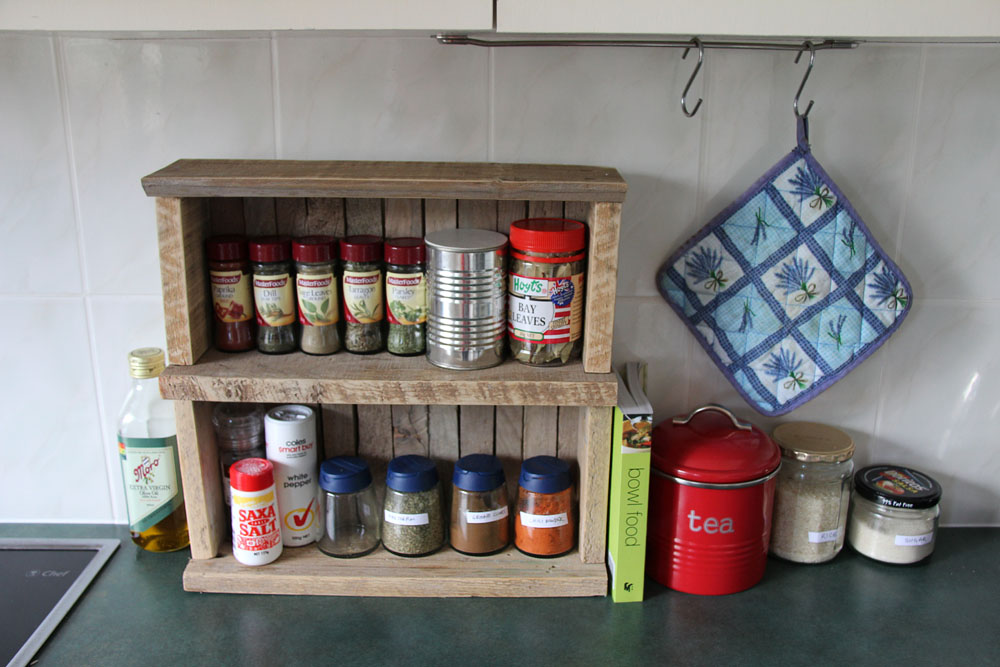
Spice rack made from pallet pieces

I also made my computer desk out of a pallet.

…and some stuff from other recycled bits of hard rubbish I’ve found around the neighbourhood:

Bits of a discarded dining room table and loose metal scraps

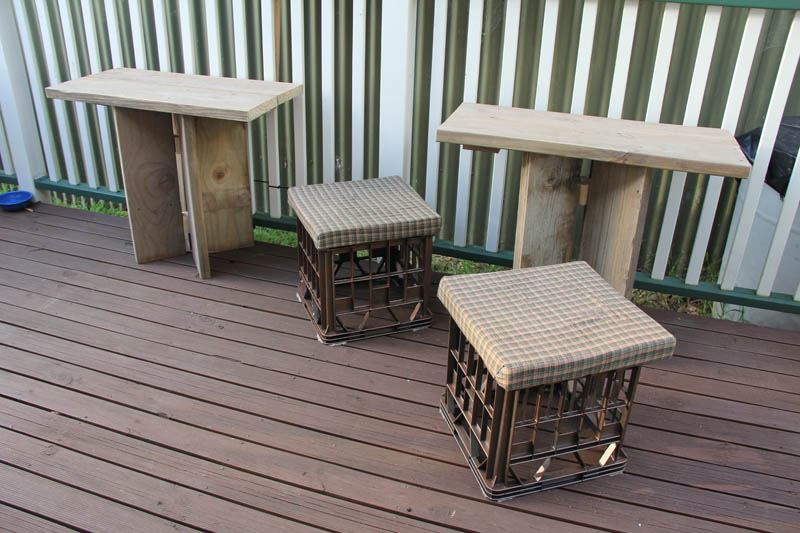
Crate seats with op-shop fabric seats and found wood for the tables

Do I Need It? poster

Do I Need It?

web version of Do I Need It? poster

Here’s a poster that I designed which was conceived of by my friend Penny. I think she’s done a great job of streamlining a path that everyone should go on to decide on whether to make a purchase or not. It essentially allows you to follow a flow-chart style path to determine whether or not you can really justify purchasing that new so-and-so that you’ve got your eye on. If everyone just diverted from that new item path more often, we’d become more responsible shoppers!

I made it into a print-quality A3 poster size in PDF format (link below) which would be perfect for posting somewhere influential where people will see it (hint hint!).

Do_I_Need_It-poster – A3, 300dpi PDF

Wealth reduction and appreciating what we’ve got

This is just a thought that popped into my head so I’m going to explore it a bit and see what comes of it: people with more money buy more stuff. Yes, I know, a revolutionary thought, hey?

Well, though it seems blazingly obvious on the surface, I was thinking that money – however you come by it – breeds a type of laziness once you have a certain amount of it. Now, it may take a lot of effort to make the money in your work or career, and we all need to get certain essentials in life that cannot be acquired secondhand or made from scratch, but it seems that once you’ve hit a certain earning (and perhaps “busyness”) threshold, then if something needs repair or has “fallen out of fashion” or performs a very specific task that could be done by something else but we decide we “need” that particular tool for the job, well then we just go out and buy a new one.

For example, in the realm of repairing an item, I’ve seen it happen often that someone who can afford to replace an item will not bother mending a fixable item, but will effortlessly replace it. The earning threshold they have achieved has now put them in the mindset of “why should I bother to spend the time/effort to fix this (and it’ll look unappealing then anyway), when I can go out and buy a new/better one?” While this might be true of a well-worn item that you’ve had for decades and is overdue for a replacement, it often is the case with an item with only superficial repair needs, but it’s the time it takes and the effort required which determines the fate of this otherwise intact item.

It’s all a bit lazy and I think accounts for a lot of our society’s waste of resources (see the important and entertaining Story of Stuff for what I mean). That laziness, I believe, stems directly from that financial threshold that this person might have achieved from a number of reasons:

1) they may work so much that they claim that there is no time to spend on repairing something. They also have “better things to do” with their time
2) they have a status to maintain with peers so an aging or obviously repaired item will simply look tatty in amongst their swishy other stuff
3) there is a certain power or thrill in being able to wield this financial prowess at will. Picking a brand-new item fulfills our society’s need to buy and consume

To me, this all boils down to having too much money. You always hear stories of people who started small, living it tough but working their way to bigger and better things. While that’s truly honorable in some ways, it reflects our mindset in our society that success is all-important and we see those early days as a necessary evil en route to financial freedom, comfort and wealth. What I don’t understand is why those early days are considered a negative to get through as quickly as possible? It’s in those early days of honest labour and frugal living where we probably make our most genuine relationships, where we value every dollar we earn, where we respect others who are in the same boat as us and where we are anything but lazy. Take that ultimate goal of becoming wealthy out of the picture and just be happy living at that level all the time, and suddenly the mindset changes.

In terms of buying stuff versus fixing stuff in this context, the solution is to reduce our need for greed. If we realise that time for ourselves and relationships should come first, and with that extra time we will also slow life down to a meaningful speed, then we’ll time to do other things than just work. This will cascade to a lower income which will allow for less flamboyant spending. However, that appreciation for what we have will return, and we will be happy to repair something when it needs it as our focus will become less about our stuff and more about the increased time we will be able to spend with friends and our own projects. Our improved relationships with family and friends will lessen the need to supplant that part of our lives with stuff and a sustainable level of wealth more similar to your friends will negate the need for showing off as the relationships will be rich enough to overlook such trivialities.

Beyond that, due to our withholding from buying stuff we don’t need, our impact on the planet will be vastly lessened which will ultimately lead to a better world. Increased recycling of goods through hand-me-downs, selling secondhand goods and people just holding onto what they have longer, will greatly reduce the number of factories being built for new items, resulting in less pollution, fewer resources being used in production and lessen the waste of items going to landfills.

The sea of benefits of this type of sustainable living attitude over the selfish and wasteful attitude that seems to be gaining strength around the world seems to be obvious, but we are still hampered by our governments and money-hungry corporations breeding us into money-lusting monsters.

Within my own life, it wasn’t until I pulled back from this supposed allure of making as much money as possible and being seduced by the shiny new toys in the shops, that I realised how much richer, slower and more fulfilling life can be. And that there’s a great satisfaction in building or repairing an item over buying something new!