Vegan foods reviewed – sour cream showdown

Here we go with some vegan sour creams as I’ve been in that mode lately. These feelings come and go as I occasionally channel my 20-something self from the 1990s when I lived in Brisbane and engaged in post-nightclub late-night binges of CCs and sour cream courtesy of my friend Christine. My current corn chip of choice of course has no cheese, but I am somewhat addicted to Nature Delight’s Tasty Lime and Chilli chips which I wouldn’t even bother reviewing as I would just be carrying on about the generous coating of spices on every chip 😄😄😄

Now I know to non-vegans there is a feeling that the idea of vegan sour “cream” is an unholy concept given the expectation that this is wholly a dairy confection. As vegans know, dairy is scary (please have a quick read of my blog post on this topic for more info!). Despite the fact that most recipes can be successfully veganised these days, there are some standalone food items that are more challenging to replicate, particularly if you are someone who traditionally believes that there is only one way for things to taste. Sour cream is one of those things that poses a bit of a challenge to vegan food producers and we are here to test the current crop of options.

I haven’t had dairy sour cream for quite some time, but the recollection is to achieve a balance of creamy smoothness which is also pleasantly tart. Some early or hasty vegan brands used lemon for the tartness but it is a clumsy approach that creates an inferior result. These offerings employ different tactics to varying levels of success. Today we look at an old favourite as a bit of a baseline comparison with a couple of recent finds.

vegan-symbol

These reviews are particularly geared towards former omni eaters who are keen to have that meat or dairy favourite available as a tasty cruelty-free equivalent.

About the ratings system: Ratings are for what I consider the important elements of an appealing food product, with “Texture” being one that you might not normally see for other food reviews, but to me it is quite indicative of the success of a meat or dairy substitute. I choose “Value” over “Price” as vegan foods are generally more expensive than their meat or dairy counterparts (or rather, the latter are unreasonably and irrationally cheap given what they are) so I choose to focus on how good they are for the amount you pay.

On to today’s reviews:


** SOUR CREAM SHOWDOWN **

PRODUCT 1: TOFUTTI BETTER THAN SOUR CREAM

Type: non-dairy Sour cream
Country of origin: USA
tofutti.com

259850

overall-5
flavourrating-5
texturerating-4
valuerating-4

vs


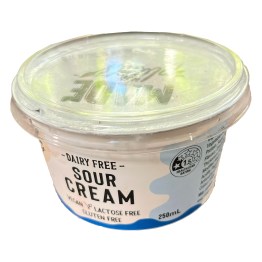
PRODUCT 2: MADE WITH PLANTS
Type: non-dairy Sour cream
Country of origin: Australia
madewithplants.com.au
9415

overall-5
flavourrating-3
texturerating-3
valuerating-4

vs


PRODUCT 3: DIBBLE
Type: non-dairy Sour cream
Country of origin: Australia
dibblefoods.com.au

9415

overall-5
flavourrating-5
texturerating-5
valuerating-5

REVIEWS:

New to my world is the Dibble brand which is out of Melbourne. It is presumably a niche brand as I have only seen it at a Foodland here in Adelaide which I know specialises in a larger variety of vegan smallgoods. Having tried a few dodgy sour cream attempts, I am always wary of wasting my hard-earned $$ on a big fat disappointment, but Dibble thankfully came through with the goods! Their jar says “New improved recipe” and what I noticed with online reviews of their first version was that people had a problem with their faba bean ingredient giving an unpleasant texture (we’ll talk to you in a sec, Made With Plants). What they do very well in this incarnation is to ditch the faba bean and introduce pea protein and natural gum guar, the latter of which the Tofutti uses. While having a very different texture to the Tofutti, it has a firmer almost “whipped” texture which is quite appealing (though I suppose, not technically identical to dairy sour cream). Where Dibble really shines is coming up with an excellent balance between the tart and the creamy. I personally don’t like it too tart but I still do want it there.

The Made With Plants grew on me in the sense that it smells and has the tangy taste of a dairy-cultured cream which is possibly the most accurate of this group to its dairy counterpart. Whether that is what you want is another thing. I find it almost a bit too sour as if it is going off slightly. What I didn’t care for was the runny “thickened cream” texture nor the distinct faba bean “after-tongue”. Yes, I think I made up a word there. You’ll know if you try it: you have a bite, swallow and then are left with a weird “glaze” on your tongue which is not too pleasant in my opinion. I definitely think it’s the faba bean though it could be one of the thickeners.

The Tofutti is a very different beast. The texture is a clearly firmer than dairy sour cream or the others here, but if you stir it, it whips up into a super-smooth confection. Its versatility comes in that it is not too sour but enough so in a subtle and accurate way to be definitively sour cream so it can be blobbed on top of nachos, or stirred into a mushroom stroganoff or just anything needing a sort of neutral thick and creamy stir-in. On it’s own it is also very good, though you start tasting that it’s not quite the same as the dairy version; however, I don’t recall ever eating sour cream straight from the tub anyway.

The verdict is a close-call: I love the ease and versatility of the Tofutti, but the Dibble was an appealing balance of all sour cream attributes. It’s also cheaper than the Tofutti which is a US import, so definitely adds to the costs a bit due to that. Made With Plants sadly isn’t really a contender with the other two according to my palette, but it is quite sour if you like that sort of aspect of a sour cream. The tongue glaze knocked it down a notch for me though.


Thanks for reading! Let me know what your favourite sour cream is so I can check it out or review it. What do you love about it? Do you disagree with my assessments? Let’s fight! 🤣 No, I’d love to know as we all have different tastebuds 😁

Plant-based paradises: Chiang Mai

It’s getting easier to find vegan products in shops and cafes in the western world, but despite this it is still not as ubiquitous as I’d like. As far as I feel like we’ve come in Australia, I still have to hunt around for restaurants which are often a decent drive away from my suburb, or I get stuck with the usual terrible quality in convenience stores, petrol stations and corner chip shops.

There are places in the world, however, where there are plant-based options around every corner, especially when global tourism collides bringing together an amassing of worldly-wise visitors demanding ethical food options.

I am in one of those places now: Chiang Mai, Thailand.

Going back a few years, CM was already rising to meet the needs of vegans even though the momentum had not yet really hit its stride in the West. Coming back now, I’m am in plant-based paradise looking at the abundance of not only 100% vegan establishments, but a general awareness in many cafes that acknowledge and allow customisation to accommodate non-meat and dairy customers. My favourite phone app (also a website), Happy Cow, shows off the glorious results of Chiang Mai’s options with so many green pins (100% vegan) but encouragingly so many others with genuine accommodating options.

Screen Shot 2019-02-01 at 2.40.57 pm.png

Chiang Mai’s central tourist area around the Old City. Scale of this image is approx. 4km across

By contrast, my hometown of Adelaide, Australia – while improving every year – will have restaurants/cafes that offer “veg options” (red pins) but quite often that will just mean that one main meal on the menu is veg-friendly and even that might still have cheese on it. On top of that, the majority of the listings above in Chiang Mai are restaurants open all day; in Adelaide, over 75% of all vegan or vegetarian establishments are only open at lunch.

IMG_8300.jpg

Mouthwatering massaman curry with brown rice and salad at Bohdi Tree 2, Chiang Mai

The quality of the food in Chiang Mai varies like anywhere, but often it is at a very high standard. I have tried a variety of cuisines (lots of Thai options of course, but often Italian, American, Middle Eastern and Indian are the one that are covered well) plus exotic salad shops, street stalls and specialty places like dessert cafes. There are many places doing their own mock meats or non-dairy cheeses, etc to varying success as I suspect that finding international commercial products is not as easy or viable to keep costs down, but this also provides some great opportunities for chefs to try something different.

As competition increases, it’s easy to start pitting one vegan place against another. However, I am still gleefully just trying places, thankful for so many ethically-minded people and in a state of awe at the variety of options at my disposal. I try not to be too critical as I want this industry to succeed, and luckily much of the food equates to hardy home-cooking which will always satisfy on some level. To be fair, I am also not seeking out high-end eateries as there are so many low-to-midrange ones, so if you’re after fine dining, there might be fewer places available for you.

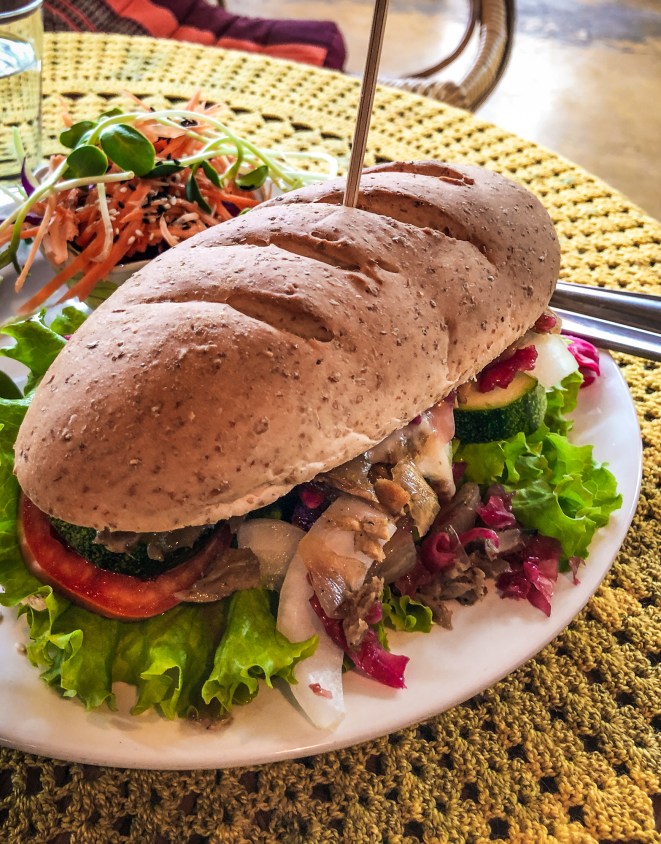
I have also visited Pai – about 4 hours’ drive from CM – and it too is well-endowed with vegan options given it’s tiny size. Check out this delicious mushroom-based bbq “pulled pork” roll I had plus gorgeous choco smoothie at Blossom Cafe.

The future is bright and the menus are exploding with choices!

IMG_8498.jpg

img_8499

Vegan food shopping pet peeves

htrbqvair2pz.jpg

Being vegan ain’t always easy. Actually, a lot of the time it gets me either really sad or truly angry. That is actually rarely about the food itself and more about the politics of raising animals for meat and dairy, the inherent cruelty of our animal agriculture system and the wilful destruction of our planet to feed people so-called “food” they don’t actually need to eat in order to survive.

When it does come down to the food though, there are so many great options, who can complain, right? Well, now… 😬   Here come my pet peeves (of today):

Unnecessary infiltrators

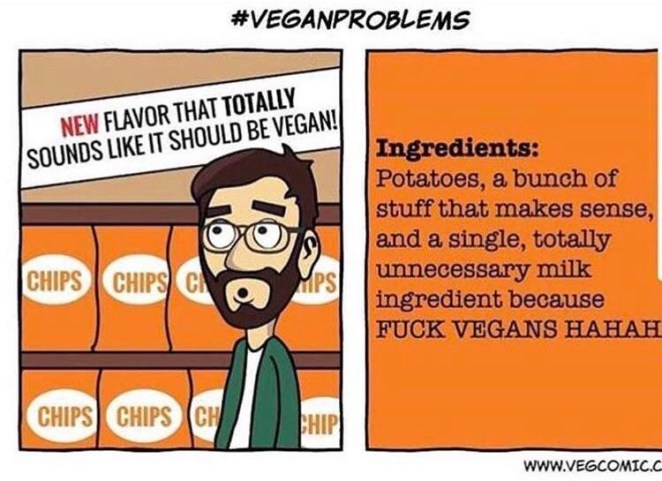
There could be SO MANY more vegan-friendly foods if companies that make an otherwise vegan product either slip “milk solids” or something stupid in there, or have a “May contain” list that includes dairy, eggs, etc even though the product doesn’t have those things in it. This happens far more often than it should!

Who decides on what the “perfect” hot dog is anyway?

There is a perception by meat-eaters and vegans alike that a vegan product has to faithfully reproduce the best version of a meat or dairy product or else it will be deemed unsuccessfully. The scrutiny is unfair and besides, who’s standards are we going by? In any food discussion, you’ll have people who swear by a certain thing, and someone else who thinks it is terrible. There is almost no gold standard for anything so we may as well get creative. If something “isn’t quite a meat item” but tastes awesome and looks very different, does it matter? If taste is paramount, then it should win out no matter what it looks like, even if the mock-meat is grey or a funny shape. If it looks weird AND tastes bad, well, that’s different. However, if it tastes “wrong” because someone was trying so hard to make that, say, blue cheese equivalent look, smell and taste identical, then maybe we need to address why it can’t just be it’s own thing. We need a new food category where foods are totally new but independently taste great without comparative scrutinising.

Making the food secretly vegan

Products that don’t mark specifically that they are vegan, nor dairy free and yet on the ingredients they have no animal products. If it isn’t on their allergens list (which they legally need to have) then it should be fair dinkum vegan, right? If so Food Company, why not just put vegan-friendly or dairy-free on the box?? Why make vegans hunt around and then take a risk or have to waste time contacting the manufacturer? You’re missing out on a growing market here people!

“Green-washing,” vegan style

Why is the vegan equivalent of a meat or dairy-based product by large companies still charged at a higher cost than the original meat/dairy item? Bigger companies are actually saving money on their core ingredients and their R&D departments are already well-funded and aren’t needing to recoup their development investment the same as a boutique company might justify their higher prices.

I am aware that animal products are heavily subsidised plus farmers are paid a pittance for what they do (which, in turn, results in the animals getting treated horribly in order to keep some profit margin). But pulses, veggies, grains and so on are cheap…

Of course, as I’ve been told before, the price of meat and dairy in western nations is unsustainably competitive. The “true” tally of our grocery bill should be about 2-3 times higher than it is, so maybe vegan foods are closer to the “real” cost. So while this one is a pet peeve because I just want to pay the same as everyone else, I could understand this price inflating if that were the real reason. However, I think it is just good old fashioned gouging.

Vegan options all in one spot

This one is more of a wish than a pet peeve I guess, but it would be utterly fantastic if vegan-specific products either got a special coloured tag at grocery stores or were all clustered in one area of the store. At the moment, the cool and frozen products tend to be together in their respective sections (albeit sprinkled together with vegetarian and gluten free and low fat – all things very much not vegan or just irrelevant to veganism) but the other products are often dotted around the store. Probably the former idea of a bright tag would be better as you cruise around the store, but either way I’m sure there are countless products that I simply miss which is unfair to the producer….and to mah belly! 😂

To end on a positive note though, I’m very thankful for all the people that are doing their best to give vegans a growing bounty of options! One day soon we’ll see a real respect by stores, food companies and the general public alike in accepting vegan foods as a genuinely profitable area worth exploiting at the benefit of our planet, our animals and us. 😊

844e0ae3da7976db794bd5cfe8c5a5e9

Why do vegans eat faux-meat and mock-dairy?

A question that is frequently asked of vegans is: if you are against the idea of consuming animal flesh and think that humans don’t need it, then why do you eat pretend meat and dairy products? While not all vegans eat faux meat depending on how long they have been vegan and why they gave up meat in the first place, there is a large market for mock-meats by vegans for good reason. For the most part, this can be boiled down to tradition, flavour, protein and social-acceptance. But let’s unpack it a bit…

vegan-hot-wings-processed-stills-11

Buffalo hot “wings” recipe at The Edgy Veg

If we first dial all arguments back to core rationale, vegans are either:

  • fighting for animal cruelty to be vastly reduced,
  • environmental chaos caused by animal agriculture to be stemmed,
  • vast health improvements that can be had by reducing animal intake in humans, or
  • a combination of the first three.

The main things that meat-eaters have on their agenda besides basic sustenance are: flavour and protein. And maybe “tradition”.

Looking at faux meat and dairy strictly from the omni “flavour” perspective, the past 3 or 4 years in particular have seen an immense increase in not only the volume of great-tasting vegan products, but a rise in innovative preparation of those products which is delivering vast improvements in taste and texture.dnLzZYG

If a meat-eater hasn’t tried vegan products for over 5 or 6 years and are still claiming vegan meats are tasteless and rubbery, they are basing their assumptions on early incarnations that used more basic technology and ingredient arrays to contribute to a much less exciting flavour. To be honest, anyone would be forgiven for criticising early vegan foods, many of which are inedible by today’s high standard of gastronomic delights.

In addition to flavour, the nutritional component to many vegan products is at a very high standard. In an effort to further attract buyers that may be looking for products strictly for health rather than compassionate reasons, there are countless organic, gluten-free, preservative-free, low saturated fat and low GI foods made from whole foods which make “going vegan” an even healthier option. Given that these foods are now marrying health and full flavour to create an alternative to most meat and dairy items, there seems less and less reasons to be able to rationalise breeding, raising, feeding, torturing and slaughtering sentient beings and then storing hunks of rotting animal carcass in order to obtain something that can be done an a far more humane, efficient and nutritionally complete manner.

Speaking specifically on protein, thanks to an increasing array of comprehensive studies, we are able to confidently strike back at nay-sayers when it comes to a plant-based diet. One such large study recently compared the nutrient profiles of around 30,000 non-vegetarians to 20,000 vegetarians and around 5,000 vegans. We now know that vegans average 70% more protein than the recommendation every day (RDI). Protein is by far the most overstated nutrient. People are unnecessarily obsessed with protein – but it’s very, very difficult to actually be deficient in protein, and only people who are falling far short of their recommended daily calorie requirement (such as people with eating disorders) will be deficient in protein. It is very easy for a vegan diet to meet the recommendations for protein. Nearly all vegetables, beans, grains, nuts, and seeds contain some, and often much, protein.

Screen Shot 2018-11-15 at 12.50.37 PM

@minimalistbaker on Instagram

So, back to the original question: why does faux meat and dairy even exist and why do many vegans seek these products out? The simple answer of course is that most vegans once ate meat and dairy as tradition led our parents to feed us that stuff, as well as being conditioned by the Powerful Influencers (corporate advertising). Now that we have left that cruelty mostly behind us, we are still left with familiar meals and flavours that we enjoyed. Seeing as we are unwilling to enjoy those flavours at the expense of an animal having to lose its life or be tortured, mock-meats became a suitable substitute. It’s not that we eat faux meat because we want to imagine the flesh that went along with it, its the seasoning, texture and flavour that is familiar and that we can have but without the cruelty.

The ethics and values of vegans are our strength, and we literally gave up on our so-called “favourite” foods because it wasn’t worth eating them if something had to die miserably or kill the planet in order to fulfil a selfish pleasure. I have great admiration for vegans who did this when there was no alternative (eg. 10, 20, 30 years ago) but to completely change their diets overnight and not be able to still enjoy the flavours they had become accustomed to. Of course, even worse back then was the fact that you were surrounded by meat-eaters giving you grief about your choices.

I would like to ask a few questions to meat-eaters, such as:

  • Why do meat eaters make food that doesn’t look like a piece of flesh? aka. sausage, burgers, meatloaf, fish fingers, chicken nuggets, etc. If humans were “designed to eat meat” then why aren’t pieces of animal sold with fur, hooves, etc so we can dig our big carnivore incisors into it and eat if fresh off the bone? Why disguise it?
  • Why do non-vegans kill animals in order to eat something that could be made with plants instead? Given that faux meats are now extremely similar in their characteristics to animal products, it literally makes no sense for people to eat something that tastes similar but where one requires a creature to die to satisfy one’s tastebuds.
  • Why do non-vegans make their food with vegan ingredients? Meat-eaters that give vegans grief are generally hypocrites as they will still eat bread made from grains, fries made from potatoes, lettuce and tomato on their hamburger, baked beans, vegetable-based soups, “meat and 3 veg”, etc etc. It’s not like they are eating meat with no other elements – maybe they should if they are self-professed carnivores. As one person said on Facebook: “Why not boil your… steak with blood or something… and season them with burned ashes”

The bottom line is: we don’t need meat and dairy. If you are a vegan reading this, then you are living, breathing proof that you are not currently dead because you are missing meat and dairy from your diet. For those meat-eaters who claim that it is their choice to eat meat, then I will say that your choice is a selfish one: the accumulated death, resource depletion and money tied up in health care due to your choice affects us all. It’s OUR PLANET TOO. Best yet, there are delicious alternatives so you don’t have much to give up!

Further reading on protein sources and amounts, especially if you are an athlete wondering how much to get, try the No-Meat Athlete or this guide at Healthline which shows specific food types and how much protein and other nutrients they provide.

Screen Shot 2018-11-15 at 12.47.36 PM

@consciouschris on Instagram

Vegan foods reviewed – part 4

I’m excited to be getting back into reviewing products, especially now that there are both so many new foods to try but also so many new vegans every day choosing a cruelty-free life! To those who might be reading, kudos to you! Even though longer-time vegans are generally good at scouring the shelves and internet for any new products, I thought I’d put my 2 cents in as well since it’s harder to find groupings of reviews in one place. Eventually I hope to make it a separate and searchable area, with links to products.

vegan-symbol

These reviews are particularly geared towards former omni eaters who are keen to have that meat or dairy favourite available as a tasty cruelty-free equivalent.

Ratings are for what I consider the important elements of an appealing food product, with “Texture” being one that you might not normally see for other food reviews, but to me it is quite indicative of the success of a meat or dairy substitute. I choose “Value” over “Price” as vegan foods are generally more expensive than their meat or dairy counterparts (or rather, the latter are unreasonably and irrationally cheap given what they are) so I choose to focus on how good they are for the amount you pay.

On to today’s reviews:


PRODUCT: FIFYA – KALE, ROCKET & WHITE BEAN DIP
Type: Snack food
Country of origin: Australia
Quality Food World

overall-5
flavourrating-5
texturerating-5
valuerating-3

2505264-fifya-vegan-dips-kale-rocket-white-bean-250g-web
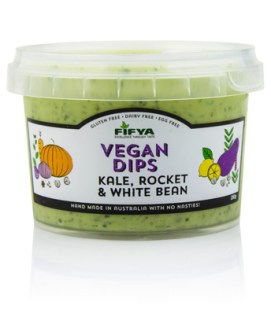
The title of this dip isn’t the most enticing you’ll come across as, on their own, none of these things are that mouth-watering items of desire. However, the way that FIFYA has combined them where the white bean becomes the creamy binding element giving it a smooth texture and the spiciness of rocket and the other flavours like pumpkin seeds, lemon juice, apple cider vinegar and olive oil round out the dip in a very appealing way.

FIFYA does a variety of vegan, gluten free, preservative free dips like roasted eggplant & parsley, pumpkin & roast capsicum plus sweet potato to name a few. I intend to try them all in due time and I’m not sure how I came to try the kale one before these more obvious  choices with “roasted” veggies (my fave) given that kale is low on my veggie list (not my fave). I’m glad it happened though, as it is a satisfying dip for snacking.

The most impressive part of this dip is the flavour which is punchy and a nice balance of savoury elements, and is perfect on crackers, pita or with fresh cut veg. The texture is smooth and good, although perhaps a bit runny and lumpy as far as dips go, but it’s not a big issue. The dips represent ok value; I am not sure if it is because they are a smaller company or if by adding “vegan” onto something they can charge more, but at $2 per container more than most of their competition for ingredients that are far from exotic, $5.50 is a bit high to pay for a 250g dip. Being 100% vegan, I will reach for it if I’m tiring of hummus but I would buy even more often if it were a bit lower in cost.


PRODUCT: CHICKPEA AND CAULIFLOWER MASALA BURGER
Type: Burger patty
Country of origin: New Zealand
Bean Supreme

overall-5
flavourrating-5
texturerating-5
valuerating-4

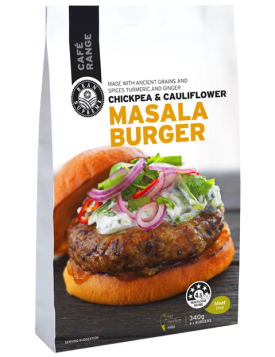
masala-burger-packaging

On first viewing of these Bean Supreme products, I find the packaging quite appealing: clean, modern and super-tasty looking food. I would be very surprised if a meat-eater would look at that image and not be seduced into trying it.

That does happen a lot with vegan foods I suspect, but the trouble is that the flavour doesn’t always match the what the image is selling. Unfortunately, even with vegans – most of whom started out as meat and dairy eaters – there is an expectation that certain foods that look a particular way will taste how we have become accustomed to them tasting. I pity the vegan product-makers who create foods with amazing flavours but someone who has a preconception might reject it simply because it doesn’t precisely match what they were expecting. Anyway, I digress…

What does that all mean with regards to Bean Supreme’s Masala Burger? Well, unfortunately the image oversells the product by a fair amount. When I first saw the raw patties, I was reminded of the ABC show The Checkout which has a segment that displays a product’s marketing photo vs what it really looks like. This was kind of the same: the patties were yellow and thinner with speckles like seeded mustard. Still, I hoped for the best and thought that as they browned they would look like the photo.

I baked them as it suggested that was a “healthier” way to prepare them, but when I took them from the oven they looked a bit anaemic, so I gave them a fast fry to brown them up. They looked better but were very dense and fairly dry compared to the juicy-looking photo. This is one of those cases where a beefy looking image was a omnivore’s nightmare, with a very-beany patty with blandish flavour. I didn’t get a sense of the intended “fragrant Indian spices” and it even was hard to dress up with some bbq sauce which I resorted to in the end.

At $8.60 for 4 patties, they weren’t the most expensive patties but they also were not that cheap, and given the competition in this category, I’d likely opt for something else before having these again.


PRODUCT: VEGANAISE
Type: No-egg mayonaise
Country of origin: USA
Follow Your Heart

overall-4
flavourrating-4
texturerating-5
valuerating-4
Organic-vegenaiseThis item has been around for awhile so it’s far from revolutionary, but it continues to be a shining example of how a vegan product can so effectively eclipse the item it is emulating.

Follow Your Heart has a lovely backstory of four vegetarian friends getting together 40 years ago to do a business that followed their ideals. You can see that there is a lot of love and successful tinkering in this product as I would say it is near-perfect. When I was an egg-eater 6+ years ago, creamy mayo had me hooked…I didn’t care for the low-quality stuff and ones that had a funny texture that was “slippery” and broke apart (like Hellmann’s) but rather liked Thomy’s very creamy and flavourful type. Vegenaise finds a good place in between flavour and texture-wise so it is as appealing as a spread as it is as a dip (the latter of which I am guilty of using it more often than anything else!).

I haven’t tried the organic version side-by-side with the regular version, so I don’t know if there is a real taste difference. I also love the garlic version which is much more aioli-like but not overly garlicky. Their byline is “better than mayo” and while I’d say that it is “as good as high-quality egg mayo” in terms of taste, the fact that it is eggless makes it far, far better.

The only thing that knocks down my score in terms of value is that I still don’t understand why there is a mark-up on vegan products when they contain no exotic ingredients (you’ll hear me harp on about this a lot 😝). At $9 per 473ml jar, it comes in 50% more expensive than gourmet egg mayos and twice as much as “regular” egg mayos. Even taking into consideration industry subsidies and economies of scale, I still think it is unnecessary to charge so much. If Follow Your Heart has been around for 40 years, they shouldn’t be considered a boutique brand anymore either.

Price rant aside, it’s one of my favourite daily-use products!


Vegan foods reviewed – part 3

It feels like I’ve semi-abandoned the vegan and sustainability part of this site but I’m getting back into it as I ramp up my focus on plant-based living and working.

The last products I reviewed were 5 years ago and wow, have things exploded in the vegan realm since then. The expanded range of options in every food group is impressive and exciting as the vegan movement takes hold of the world’s meat and dairy eaters. There are so many good dairy-free options now too, that I suspect even on-the-fence vegetarians might finally ditch their one last hold-out to full vegan eating!

I’ve made this page more extensive and visual, and will try to give variations on the same product type in order to truly compare the options that you have. I generally review products that have meat or dairy equivalents since otherwise they can just be called “food” since anyone can and does eat them.

vegan-symbol

These reviews are particularly geared towards former omni eaters who are keen to have that meat or dairy favourite available as a tasty cruelty-free equivalent.

Ratings are for what I consider the important elements of an appealing food product, with “Texture” being one that you might not normally see for other food reviews, but to me it is quite indicative of the success of a meat or dairy substitute. I choose “Value” over “Price” as vegan foods are generally more expensive than their meat or dairy counterparts (or rather, the latter are unreasonably and irrationally cheap given what they are) so I choose to focus on how good they are for the amount you pay.

On to today’s reviews:


PRODUCT: UPTON’S NATURALS – MASSAMAN CURRY
Type: Prepared meal
Country of origin: USA
Upton’s Naturals

overall-5
flavourrating-5
texturerating-5
valuerating-3

massamancurry_0.pngI have seen Upton’s moustached men gracing their product boxes on grocery shelves for a couple of years now, but was only just made aware that this Chicago-based brand has been around since 2006. Their website shows off an impressive and mouthwatering array of products, many of which we still don’t get here in Australia (I’m looking at the seitan chorizo and mentally willing someone to distribute that here!) I did, however, note that this particular one that I am reviewing – the Massaman Curry – is a “Product of Thailand” so I’m afraid to ask if the ingredients are sourced in Thailand, shipped to America to prepare and then shipped to Australia for us, meaning there’s a whopping 25,000+ kms of fossil fuels attached to this item. Eeek!

Pushing that aside for the moment, their local distributor has just started importing the Massaman and I have to say, it is bloody delicious. There is a slightly enhanced zestiness to it that I wouldn’t say is my vision of a typical “massaman”, but it doesn’t matter because the plate is empty before you’ve had long to critique that point. Rich with flavour, crisp and fresh-tasting veggies, firm and flavourful tofu – it really was a satisfyingly delish meal.

The meal comes in microwave-ready vacuum-sealed plastic pouches, with separate purple rice, curry and crushed peanuts. My only peeve is that the package says it is “2 serves” which is quite wrong. It is only a 280g/480Cal packet and the serve that I heated up was smaller than my usual single-serve of curry (and I don’t eat exceptionally large serves by any means). It is really just a light lunch size but not a dinner for 2 or “I’m rather hungry” size. Because of this, the $9 price point is a bit steep for what it is. It may well be more expensive due to importing from the US (but then I do see it at US online retailers for US$6 so that’s comparable). I could understand the seitan or jackfruit or other specialty “meats” being a bit pricer, but non-organic tofu, rice and veg shouldn’t jack up the price that much.

Overall, a great choice for a guaranteed delicious meal, though not 100% “massaman-ish” and a bit pricey for the size you get.


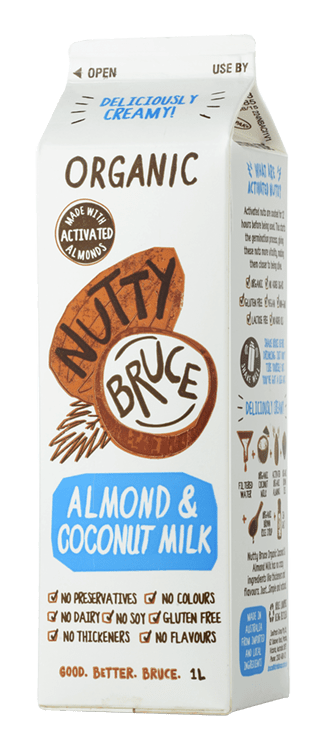
PRODUCT: NUTTY BRUCE
Type: Nut milk
Country of origin: Australia
drinkbruce.com

overall-5
flavourrating-5
texturerating-5
valuerating-4

nutty-bruce-coconut-almond-milk-2d-clipped-png-web-re-size-e1541133829246.png

Far and away the best nut milk I’ve come across to date. It is pleasantly creamy and not watery like so many long-life almond milks (probably due to having 2-3 times as much almond and coconut than other mylks). It only comes fresh (not in long-life tetra packs) so that might contribute to its more “lively” flavour too.

It is organic, has no thickeners, is slightly sweet (brown rice syrup) and is perfect for nearly everything I might have used dairy milk for in the past. When I go back to other almond milks, they taste limp and bland by comparison. Other coconut milks just taste like watered down coconut cream you’d use for cooking. It also doesn’t separate in tea or coffee like other organic milks I’ve had (I’m looking at you “Australia’s Own”).

Price-wise, it’s also the most expensive compared to any of the long-life milks. At normal non-sale price, they often sit at nearly double the price of others. Given that the others almost seem unpalatable now that I have had Bruce, it seems like good value, though it still adds up and I cringe a bit when I pile on 3L in the cart at over $17!

The brand is fun, it’s local and I love em! Yummmm!


PRODUCT: ALTERNATIVE DAIRY CO. – CHEDDAR BLOCK
Type: Non-dairy cheese
Country of origin: Australia
Alternative Dairy Co. (FB)

overall-4
flavourrating-4
texturerating-5
valuerating-4

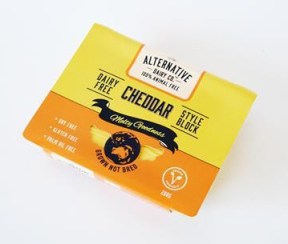
22177_cheddar.jpgDairy cheese is a strange confection as it has a property which makes it congeal and go gooey, and for some reason we have found this to be appealing. I would be lying if I said that I am not attracted to this feature when it comes to pizza or lasagne or Mac n’ cheese, but it’s still a weird thing. So of course we want our dairy cheese substitute to have the same characteristics, but many vegan cheeses struggle to simulate this well.
As far as rating a vegan cheese, this is a semi-important feature in my book as it does bug me when you make a pizza or toastie and the cheese is in a semi-solidified state even after cooking for awhile and now it is at risk of burning.

Alt. Dairy Co. has found a happy place where their cheese has excellent texture, bold flavour without a dominant coconut oil taste and pleasant meltability. It is still just cheddar, but you wouldn’t feel embarrassed to serve it to your bovine-breast milk-loving friends. High snackability on crackers or straight off the block. The feature that bolder flavoured non-dairy cheeses I’ve had might be the potato starch which I think might be the secret agent to making good faux cheese. Another favourite brand of mine, Vegusto, use potato in theirs and it is also delicious and not relying just on coconut oil to get by.

Overall, this is a great effort from a local company who are just starting to make headway with their brand. I look forward to trying more of their offerings!


Lifestyle Report – as of Mar 2015

This is my fifth Report (usually once/twice a year) as a way of assessing my successes, targets, improvements and areas I need to be more vigilant with when it comes to simple, ethical, environmentally sustainable and community living.

It might not be an interesting entry to read but it’s a way to keep myself accountable and constantly improving my lifestyle.

I’ve highlighted positive changes in green and backwards steps red. So, as of today:

ETHICAL/SUSTAINABLE LIVING

• grocery shopping (with % of how often I do it)
— observing a vegan lifestyle (due to my work and my beliefs, I allow myself some leeway but am committed to greatly reducing or eliminating meat and dairy everywhere possible (90%)
— local green grocer for veg (75%)
— leftover bread free at end of baker business day (0% – though eating less bread in general);
— skip-dipping/dumpster diving (0% – slack but they are hard to find and I’m not really looking)
— major supermarket for all else (30% – Coles/Woolies, 70% – Foodland (local);
— Fair Trade where possible (tea, chocolate, recent clothing)
— organic where possible/affordable (15% – food, soap & shampoo; some research suggests organic isn’t necessary for many things. Will have to check more on this))
— use Ethical Guide to boycott bad companies (20% – need more vigilance here as I’m going off older info at times);
— boycott GMO foods (50% where possible; as above, using old info)
— boycott food with known cruel processes (90% where known)
— food miles, locally produced (50%)
— meat consumption (0% of meals)
— dairy consumption (5-10%)
— toilet paper from Who Gives A Crap (50% of proceeds go to developing countries with poor sanitation to help built toilets) (100%)

• grow own food (10% – tomatoes, eggplant, herbs)

• household shopping: I only buy new from store if I can’t get from op shop or build myself;
— purchased new in past year:
—– furniture (0%)
—– clothes (10%)
—–accessories (15%)
—– car (0%)

• home energy:
— electricity: (house-sitting and traveling for next 6 months so we’re not contributing excessively to power consumption, plus there are mixed resources)
—– solar/renewable = some
—– aircon/heating (15%)
—– computer (off at night)
—– fridge (borrowed)
—– dryer (0%);
— water:
—– rainwater tank (50% – places we are staying)
—– grey water for garden (15% – washing machine only)
—– shower avg. duration (5 mins)
—– garden (10%)
—– dishwasher (0%)
—– washing machine (top loader 2/5 star rating)

• waste:
— food scraps (100% goes to compost);
— wasted food (5%);
— recyclables like glass, paper, aluminium cans (95% to recycle bin, 5% kept for food/household storage);
— wasted paper (minimal use of printer, kitchen & recycled toilet paper)
— wood (not saving wood at the moment as we are without a fixed address)
— white goods, electronics, equipment (0%)

Areas to Improve: fewer food miles; support local; buy organic if it makes sense & affordable; grow more of our own food; continue to consume less energy & town water. As it gets hotter, it is tempting to use aircon but we generally don’t succumb until about 35 degrees or more.

.

– – – – – – – – – – – – – – – – – – – – – – – – –

.

SIMPLE LIVING
• “homeless” for the first time since backpacking years ago. Housesitting and WWOOFing for next 6 months at least.
• buy nothing that isn’t essential to the trip or work
• work less, spend time with hosts, wife and friends
• spend money on essentials, friends, charities;

Areas to Improve: this is about as simple as it gets so just keep expenses (like eating out) to a minimum

.

– – – – – – – – – – – – – – – – – – – – – – – – –

.

ENVIRONMENTAL
• approx. annual carbon footprint (avg. based on lifestyle as of today): 4.0 tonnes of CO2 (Australian avg. 16.3 tonnes; world avg. 4 tonnes). SOme success to finally reach the global average!
• car usage per month – approx 400kms ; mileage (approx 10kms/L) – this will go up when we start our forthcoming road trip
• bus instead of drive (20%)
• ride/walk/skate instead of motor transport (20% – 3min skate/ride to shops)
• return flights in past year – domestic (1), international (1); This year was a flight for business.

Areas to Improve: take fewer flights; walk/skate/bus more rather than car; use less electricity; aim for 4 tonnes/yr CO2 including travel

.

– – – – – – – – – – – – – – – – – – – – – – – – –

.

COMMUNITY
• I live with my wife and dog; most friends are the same distance or closer now though
• intentional community living (share house or close living) = YES on this trip for next few months
• share property or resources with community = on this trip, all resources will be shared, including meal-time
• collect hard rubbish from neighbourhood (not for now, but usually, when we have a fixed address)
• engage in conversation or help with mentally/physically challenged people in neighbourhood (0%)
• give to charities (monthly to: 3 x global aid, 2 x animal, 2 x activism organisation, 1 x community fund )
• volunteer with some friends’ and charitable projects
• community gatherings for shared weekly meals and social activities

Areas to Improve: aim to achieve closer and more intentional community; share more resources; give more to charities; get more involved with meaningful & helpful projects

MAR 2015 SUMMARY: I’m still struggling to directly engage in the areas I want to see change (other than lifestyle – vegan, simple living, low-impact, recycle/reuse/repair), namely animal protection and climate-related. I guess it’s hard to know how to make a living while doing it. I’m not one who is big on studying so that’s one problem. If I can meld my interests in filmmaking and other artistic pursuits with my activist desires, I can probably make a big go of it. The follow on to that would be hanging out with a more like-minded community which would likely include lowering environmental impacts further plus be a better group to live with from the point of view of emotional connection. We’ll see how our forthcoming trip to visit intentional communities and like-minded groups fares!

Have yourself an ethical little Christmas…

As Christmas approaches, I am feeling very passionate about reducing the amount of cruelty-created products in my life and the lives around me, so I’m hoping you’ll take a PLEDGE to try to do this yourself this season.

Christmas represents a time when people gather for meals, share gifts and eat too much chocolate. All I am hoping is that you’ll consider reducing your intake of animal products and if you do, then source Fair Trade or ethical/humane options (see options below). And with the gifts you purchase, please consider where it came from and reduce the likelihood that it was procured using slave labour.

Some suggestions:

— chocolate: please avoid milk chocolate as the milk comes from antibiotic-filled, tortured animals. Especially the cheaper chocolate which will also be using cocoa beans picked by slave labour. With cheap chocolate, you are usually also supporting a multinational company that cares nothing about welfare and only about bottom-line earnings. Aim for dark chocolate with the Fair Trade logo on it http://fairtrade.com.au/  If you think you can’t afford to pay a bit more, chances are you should just save your money altogether and not buy ANY chocolate as neither you, nor the planet, can afford the cost of this luxury!

— meat: try to find alternative options to meat altogether. With everyone ramping up with their traditional of consuming a bounty of meat they usually eat this time of year, the number of animals slaughtered reaches an epic and horrifying high (Kill Counter: the moment you open the following web page, it tells you how many creatures have been killed from that moment on to deliver you the range of foods that humans have come to expect. I challenge you to watch it for 1 minute and then honestly assess how you feel about the totals you see: http://www.adaptt.org/killcounter.html )

If you MUST have some meat, please don’t buy the cheapest cuts which will definitely come from abusive factories. It’s not just how MANY animals are consumed, it’s how miserable they lived their lives. Why would you want to eat something that was terrified, miserable, orphaned and murdered? Look at the Humane Choice website ( http://www.humanechoice.com.au/ ) as an example of where to get ethical meat and eggs. Remember: every creature on this planet has the SAME RIGHT to be on this planet as YOU DO.

— consumer products: here’s a great guide to why it’s important and what/where you can buy to ensure a better chance that you’ll be getting stuff not made by slaves: http://www.ethical.org.au/consumer/christmas/christmas-gifts.htm There are also lots of charitable organisations like TEAR’s Useful Gift catalogue ( http://www.usefulgifts.org/ ) where you get to give something that actually helps someone else in a life-changing kind of way. It is after all the season for GIVING, right? 🙂

I try to live by these examples but none of us are perfect. However, if we all pledge to try to eat 50% less dairy, 50% less meat and be wary of where are other ‘stuff’ is coming from, that will already represent a positive change.

Will you take this pledge?

Lifestyle Report – as of Nov 2013

This is my fourth Report (usually once/twice a year) as a way of assessing my successes, targets, improvements and areas I need to be more vigilant with when it comes to simple, ethical, environmentally sustainable and community living.

It might not be an interesting entry to read but it’s a way to keep myself accountable and constantly improving my lifestyle.

I’ve highlighted positive changes in green and backwards steps red. So, as of today:

ETHICAL/SUSTAINABLE LIVING

• grocery shopping (with % of how often I do it)
— observing a vegan lifestyle (due to my work and my beliefs, I allow myself some leeway but am committed to greatly reducing or eliminating meat and dairy everywhere possible (90%)
— local green grocer for veg (75%)
— leftover bread free at end of baker business day (0% – though eating less bread in general);
— skip-dipping/dumpster diving (0% – slack but they are hard to find and I’m not really looking)
— major supermarket for all else (20% – Coles/Woolies, 70% – Foodland (local);
— Fair Trade where possible (tea, chocolate, recent clothing)
— organic where possible/affordable (25% – food, soap & shampoo)
— use Ethical Guide to boycott bad companies (50% – need more vigilance here);
— boycott GMO foods (70% where possible)
— boycott food with known cruel processes (90% where known)
— food miles, locally produced (50%)
— meat consumption (0% of meals)
— dairy consumption (5-10%)
— toilet paper from Who Gives A Crap (50% of proceeds go to developing countries with poor sanitation to help built toilets) (100%)

• grow own food (10% – tomatoes, eggplant, herbs)

• household shopping: I only buy new from store if I can’t get from op shop or build myself;
— purchased new in past year:
—– furniture (0%)
—– clothes (10%)
—–accessories (15%)
—– car (0%)

• home energy:
— electricity:
—– solar/renewable = no
—– aircon/heating (15%)
—– computer (off at night)
—– fridge (2/5 star rating)
—– dryer (0%);
— water:
—– rainwater tank (0% – no longer have one)
—– grey water for garden (15% – washing machine only)
—– shower avg. duration (5 mins)
—– garden (10%)
—– dishwasher (0%)
—– washing machine (top loader 2/5 star rating)

• waste:
— food scraps (100% goes to compost);
— wasted food (5%);
— recyclables like glass, paper, aluminium cans (95% to recycle bin, 5% kept for food/household storage);
— wasted paper (minimal use of printer, kitchen & recycled toilet paper)
— wood (90% saved for building material); haven’t built much now that I have what I need!
— white goods, electronics, equipment (0%)

Areas to Improve: fewer food miles; support local; buy organic if it makes sense & affordable; grow more of our own food; continue to consume less energy & town water. As it gets hotter, it is tempting to use aircon but we generally don’t succumb until about 35 degrees or more.

.

– – – – – – – – – – – – – – – – – – – – – – – – –

.

SIMPLE LIVING
• build most of my own furniture (lounge daybeds, coffee table, office desk, outdoor tables & seats)
• other furnishings have been donated (bed, futon, tv & DVD) or secondhand (kitchen table & chairs, office chair, rug);
• buy nothing that isn’t essential to the household or work
• work less, spend more time connecting with friends & family; (has been a very busy past 3 years. Trying to find that work-life balance again)
• spend money on essentials, friends, charities;

Areas to Improve: connect more with real (not virtual) people

.

– – – – – – – – – – – – – – – – – – – – – – – – –

.

ENVIRONMENTAL
• approx. annual carbon footprint (avg. based on lifestyle as of today): 4.5 tonnes of CO2 (Aus avg. 16 tonnes; world avg. 4 tonnes). This is not including my poor flight behavior below 😦
• car usage per month – approx 400kms ; mileage (approx 10kms/L)
• bus instead of drive (20%)
• ride/walk/skate instead of motor transport (10% – 15min walk to shops)
• return flights in past year – domestic (2), international (2); Unfortunately, the past couple of years have been baaad. This year was a flight for personal and one trip for business.

Areas to Improve: take fewer flights; walk/skate/bus more rather than car; use less electricity; aim for 4 tonnes/yr CO2 including travel

.

– – – – – – – – – – – – – – – – – – – – – – – – –

.

COMMUNITY
• I now live with my wife so no more commuting to see one another; most friends are the same distance or closer now though
• intentional community living (share house or close living) = no
• share property or resources with community (some household items, driving, food with my wife’s best friend; borrow from other friends occasionally)
• collect hard rubbish from neighbourhood
• engage in conversation or help with mentally/physically challenged people in neighbourhood (0%)
• give to charities (monthly to: 3 x global aid, 2 x animal, 2 x activism organisation, 1 x community fund )
• volunteer with some friends’ and charitable projects
• community gatherings for shared weekly meals and social activities

Areas to Improve: aim to achieve closer and more intentional community; share more resources; be more accepting of minority/disadvantaged; give more to charities; get more involved with meaningful & helpful projects

NOV 2013 SUMMARY: overall, doing the right things still but still not socialising much due to workload. Some areas I can still be a bit more green. Would love to get more friends to jump onboard different aspects of sustainable, ethical or green living but am still trying to take the approach of “be the change you want to see in the world” however it is not always easy not to promote/preach, be judgmental or not be hypocritical. Involving myself in a great deal more research, protests and campaigns and becoming more politically aware. Taking a strong stance against animal cruelty and using social media to regularly drop hints to friends/the public. Trying not to become overwhelmed or too despondent about the current state of the world and others’ apathy to change!

Don’t label me, please

Since assuming a vegan lifestyle and an ethical stance against animal cruelty, I’ve heard a couple of stories from friends about the strict labelling that comes with being vegan. By that I mean the term “vegan” seems to attract some sort of expectation of behaviour that is not applied to any non-vegans. I heard the second story tonight and it seemed directed at me, and it made me angry…thus this slight rant.

In the two stories I’ve heard, one couple were self-enforcing the vegan label so vigorously that they would call out anyone who didn’t strictly adhere to veganism and would feel it a personal failure to step outside that realm themselves. In the story I heard tonight, it came from the other side of the coin; a non-vegan who was ready to challenge my use of the “vegan” term as I have indicated that I intend on living a 90-95% vegan lifestyle because I don’t want to become one of those people who make life difficult for others because of the lifestyle I am adhering to. Also because I want to be realistic.

I probably didn’t make that clear to the second friend when I started a vegan lifestyle because — I imagine like most born-again-vegans — we make a sudden thrust into the vegan world for either moral/ethical, health, environmental or animal rights reasons (or some or all of the above) and so we immediately gravitate strongly to the “vegan” label. To be fair, it’s initially empowering to call ourselves that, to clearly differentiate ourselves from the animal-murdering masses.

For the record, these are the terms of my vegan lifestyle:

  • On a daily basis, I will refuse to consume dairy, meat, fish, or things containing these items.
  • If at a friend’s home, I will shift to vegetarian eating if that is all that is available and let them know I eat vegan for future reference.
  • I eat eggs that I know are from cruelty-free sources, like friends’ chooks or a certified humane farm. I am very strict about the living conditions for the chickens.
  • I will refuse where practical and possible to buy items using animal hides, like leather. I will never buy fur (besides, it’s just so last season! 😛 ). I might buy a second-hand leather item as the deed has been done and I don’t believe the wearing/using these items incriminates me because it looks like I’m supporting this industry
  • I actively support animal rights through charitable donation, researching and sharing information, plus joining activist rallies like Ban Live Export.
  • I am adamant about protecting the environment by fighting for a reduction of factory farming and changing agriculture practices.
  • However, I respect the traditional hunting practices of people who live far in the bush or like the Inuit people who take only what they need to personally survive and who ritualistically cleanse the animal when they kill it, respecting the life they are taking.
  • I actively take care in knowing which companies do animal testing on their products and then boycott that product if they are animal abusers.
  • I plan to work more directly with protecting animals in the near future

With all these things, I aim for a 90-95% success rate as I believe that we have to be realistic: while I want animal suffering to cease, I recognise that a vast reduction would be considered a “win”. We cannot change this world 100%…it is impossible. And perhaps we don’t need to either.

For all intents and purposes, I am quite comfortable working within these boundaries and still consider myself following a vegan lifestyle. What’s more (and perhaps more importantly), I don’t care if I’m not living up to someone else’s labelling (and therefore their judgement). Another person I know heard that I was eating eggs (even with my strict policy for choosing them) and announced “so I guess you’re just a vegetarian then” as if I didn’t meet the vegan standards and was therefore stripped of my title.

I must admit it makes me laugh when I hear someone judging me for attempting to live a very challenging lifestyle, one that has health and ethics at its core, but where I am perhaps not living up to the dictionary definition of it. And by “makes me laugh” I mean I want to beat them with a hypocrisy stick. There is not one single way a meat-eater can make a judgement on the effectiveness or competency of someone who is working hard at their vegan lifestyle without sounding like a complete tool. That’s why I really dislike the label; it’s too easy for people to want to score you on how you’re doing with it.

I know this is sounding a bit like a rant but my wish is simply this: if you know someone trying to follow a vegan lifestyle, please support what they are doing even if it isn’t what you personally want to do in your own life. No one is judging your meat-eating ways even though the destructive nature of meat and dairy consumption gives vegans a lot of ammunition to fire at you.

If you are a vegan, my hope would be that you can see that we live in an imperfect world and we need to do our best but not beat ourselves up (or others) who aren’t perfect vegans all of the time. Plus, we need to gently inform meat-eaters of why it might not be a bad idea to cut back on their consumption, for the better of the planet and the rest of us who must deal with the fact that agriculture is destroying it. In other words, no one should judge anyone else, but we should all be prepared to listen and adapt for the better of our lifestyles, needs and the world around us.

Let’s not be so fussy with our labelling of each other!

🙂

P.S. There is a lot of self-righteousness that comes with our choices, particularly food ones. My wish would be that everyone be open to arguments on both sides of the meat/vegan debate, concede when someone has a valid point on either side, and stop letting personal pride dictate how “right” you think you are about following what you believe. Let’s all just try to make informed decisions and then we might see that personal labels are pointless anyway.