Green Smart Pots

I was in South Australia’s McLaren Vale wine-growing region recently and met a lovely gentleman and olive farmer named Tony who sold us some tasty homemade olive oil and then proceeded to show us some of his organic veggies. He had this amazing veggie patch with beautiful, healthy herbs and veggies all growing in these plastic tubs. He mentioned a business that his uncle had started called Green Smart Pots which were what we were observing here which have a clever self-watering system especially designed for Australia’s strict water restrictions. Little “wicks” draw the water up from the base and keep the plants healthy without over or under-watering them. This sort of thing has been around for awhile, but these were excellent designs that we could see working beautifully with our own eyes.

This is something I have been putting off due to being in a rental house situation and not wanting to alter things too much. That, and also not wanting to put a lot of effort into a garden only to leave one day and not be able to take it with me. This system definitely solves both problems and gives people with even the most modest amount of space a way to grow their own food and steal back from the big grocery stores the expensive, chemical-covered, food-mile laden and generally poor excuse for fresh veggies and herbs that they peddle!

Actions + words

Sometimes I think it’s easy to say but not do (when really you should), while other times you do but don’t tell (when really you should).

I find it’s so easy to either say or think that I should be doing something a certain way (like being more ethical, doing more exercise, helping people, eating more healthily, being more pro-active with many things, stopping unproductive behavior…to name a few), but then get stuffed up when it comes to putting these things into practice. Conversely, some activities are easy to do (eating unhealthily guilt-free, spending too much time on Facebook, enjoying the company of friends), even ones that might have been difficult in the past or are sometimes difficult for other people too (living simply with less stuff, earning less, shopping a bit more ethically/organically/fairly, focusing more on other people than myself), but don’t get talked about.

For example, today I woke up with a wretched pain in my back from an albeit long, 13-hour workday shooting a wedding yesterday. Fair enough, I was on my feet nearly the whole day, but the pain was made worse due to my aversion to exercise. Even simply doing a few crunches every day will strengthen my torso and keep my back from bearing all the load. I know this stuff, but I don’t just do it. A few minutes a day will save my ongoing pain and yet I just can’t get myself to expend the effort. I even say these things to myself while sitting in the kitchen eating a block of chocolate (Fair Trade chocolate, at least!). Sigh. These words are something that need some action attached to them!

On the contrary, I have surprisingly easily slipped into a low-consuming life, becoming quite adamant about staying away from consuming holy lands (aka. shopping malls), taking a hard line about racking up credit card debt, building my own furniture, being careful what I eat and how much I eat out, and being satisfied in general with less. While I act this out every day, it wasn’t until very recently that I’ve been talking up this lifestyle (in this humble little bloggie-blog!), something I still feel a bit funny about though as I am not pretending to know what I’m talking about.

Perhaps what I’m trying to decide is when is it important to just act with no words, when is it good to have words but no action and when do you need both?

I’m always quite happy to lavish my lovely girlfriend, Heidi, with lots of thanks and praise for guiding me into this more responsible world of frugality and giving, but she has learned with her lifestyle choices that sometimes actions need to speak for themselves. As I believe she quite rightly assumes, people are very reluctant to be told that they are doing something wrong and should change; they need to just see how it works for someone else and feel inclined to question why you do what you do. Seeing that this way of living or things that you’re doing makes them happy or less stressed or just feels right, might incite them to do it themselves, or at least ask more questions. One can always hope that if it’s a good thing, the idea or action will cascade through to their friends and so on and so on

Maybe words and actions are both required sometimes though; I was just reading from a brilliant and well-written book The Rough Guide to Ethical Living, and they suggest that it’s all well and good to eat organic, shop Fair Trade and make other ethical decisions about where your food and products come from, but sometimes the action of making the right choice needs to include a message that communicates what you’re doing. Simply making the choice doesn’t specifically tell one brand or retailer why you’re not shopping with them (if it’s due to their brand/product being seen as having poor production practices, eg. treatment of people or animals, poor emissions, or marketing practices); you need to not only make the purchase, but indicate what your problem is with the other brand/product. Even more ideal and impactful in terms of acting and telling is to cut your own carbon emissions then writing to your local MP and “encouraging them to lean on the government to pass legislation which requires everyone to reduce their greenhouse emissions.”

This is sound advice; I think I’m going to get into the habit of regularly writing to retailers (like, Coles – boycott Nestlé!), writing to brands (like, Nestlé – irresponsible marketing practices!) or MPs about a variety of green/sustainability things. I hope anyone reading this can challenge themselves to put into action at least one thing that they have been telling themselves to do but haven’t acted on it; or conversely, if you’re doing something great but no one knows about it that’s ok but you could be influencing a whole lot more people with being a bit more pro-active with letting them know about it! But don’t listen to me (yes, listen to me! heehee).

Not Buying It

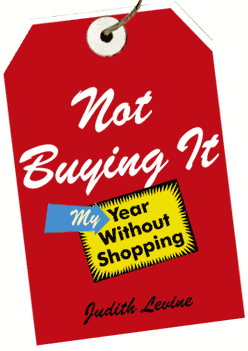
I’ve just been going through a mini bout of poverty: no jobs rolling in, Christmas costs just past, bills to pay, etc. So I’m down to a few cents in the ol’ bank accountaroodle. But it’s all good. Great actually to be firm with myself about delving into credit just so I can live comfortably rather than tightening up and just doing less, spending less and eating what’s left in the cupboard Not Buying It book cover(it’s surprising how many meals you can make when you think the cupboards are empty! In fact, during my housesitting period, I chucked out countless boxes worth of old food from people’s cupboards that could’ve saved them $$ heaps on buying new stuff when they didn’t need to…anyway, that’s another story!).

Coinciding nicely with buying less and just dealing with it, Heidi and I have started reading a book called Not Buying It by Judith Levine. It’s started off a bit doom-and-gloom as many of the books I’ve read of late about climate change and unsustainable practices are, but it looks to be an interesting read as she chronicles a year of her life not buying anything that is “non-essential”. She keeps a chronological journal that shows how she does through a whole year of reducing her consumeristic behavior.

In general, but especially when money is hard to come by, I like this thinking. I’d love to try doing a whole year of buying only “essential” stuff but I imagine it’d be hard. With less income rolling in, I guess you’re forced into that kind of action anyway, made even more obvious when you see how homeless and under-developed nations live like this all the time. Of course, this sort of “experiment” is the extreme as most of us don’t choose to live such a hard life, but I suppose if we all pulled back just that extra bit and reconsidered the true necessity and impact of every non-essential thing we buy, we’d be making some headway with the global crisis.

Lifestyle Report – as of Jan 2011

As a way of assessing my successes, targets, improvements and areas I need to be more vigilant with when it comes to simple, ethical, environmentally sustainable and community living, I’m going to blog here in this format regularly.

It might not be an interesting entry to read but it’s a way to keep myself accountable and constantly improving my lifestyle.

So, as of today:

ETHICAL/SUSTAINABLE LIVING

• grocery shopping (with % of how often I do it)
— local green grocer for veg (25%);
— leftover bread free at end of baker business day (100%);
— skip-dipping/dumpster diving (0% but aiming to re-introduce it)
— major supermarket for all else (100%);
— Fair Trade where possible (tea, chocolate, recent clothing)
— some organic (10% – food, soap & shampoo)
— use Ethical Guide to boycott bad companies, GM food (95%);
— boycott food with known cruel processes eg. veal (100% where known)
— food miles, locally produced (25%)
— meat consumption (25% of meals)

• grow own food (not yet 0% but get some from friend 3%)

• household shopping: I only buy new from store if I can’t get from op shop or build myself;
— purchased new in past year:
—– furniture (0%)
—– clothes (10%)
—–accessories (15%)
—– car (40%)

• home energy:
— electricity:
—– solar/renewable = no
—– aircon/heating (10%)
—– computer (on 24/7, asleep when away & at night)
—– fridge (2/5 star rating)
—– dryer (0%)
—– water pump (everytime the tap is turned on);
— water:
—– rainwater tank (75%)
—– shower grey water for garden (10%)
—– shower avg. duration (5 mins)
—– garden (0%)
—– dishwasher (0%)
—– washing machine (top loader 2/5 star rating)

• waste:
— food scraps (75% to compost);
— wasted food (10%);
— recyclables like glass, paper, aluminium cans (90% to recycle bin, 10% kept for food/household storage);
— wasted paper (minimal use of printer, kitchen & recycled toilet paper)
— wood (90% saved for building material);
— white goods, electronics, equipment (0%);

Areas to Improve: fewer food miles; support local; buy organic if it makes sense & affordable; grow some own food; consume less energy & town water.

.

– – – – – – – – – – – – – – – – – – – – – – – – –

.

SIMPLE LIVING
• build most of my own furniture (lounge daybeds, coffee table, office desk, outdoor tables & seats)
• other furnishings have been donated (bed, futon, tv & DVD) or secondhand (kitchen table & chairs, office chair, rug)
• buy nothing that isn’t essential to the household or work
• work less, spend more time connecting with friends & family
• spend money on essentials, friends, charities

Areas to Improve: connect more with real (not virtual) people; volunteer more time to help others

.

– – – – – – – – – – – – – – – – – – – – – – – – –

.

ENVIRONMENTAL
• approx. annual carbon footprint (avg. based on lifestyle as of today): 9.24 tonnes of CO2 (Aus avg. 16 tonnes; world avg. 4 tonnes)
• car usage per month – approx 500kms; mileage (approx 10kms/L)
• bus instead of drive (15%)
• ride/walk/skate instead of motor transport (15% – 20min walk to shops)
• return flights in past year – domestic (4), international (0)

Areas to Improve: take fewer flights; walk/skate/bus more rather than car; use less electricity; aim for 7-8 tonnes/yr CO2

.

– – – – – – – – – – – – – – – – – – – – – – – – –

.

COMMUNITY
• I live walking distance to my girlfriend and a couple of other friends; 5 minute drive to a couple more
• intentional community living (share house or close living) = no
• share property or resources with community (some household items, driving, food with girlfriend & her housemate; borrow from other friends occasionally)
• collect hard rubbish from neighbourhood
• engage in conversation or help with mentally/physically challenged people in neighbourhood (50%)
• give to charities (monthly to: 1 x global aid, 1 x animal, 1 x heart foundation)
• volunteer with some friends’ and charitable projects

Areas to Improve: aim to achieve closer and more intentional community; share more resources; be more accepting of minority/disadvantaged; give more to charities; get more involved with meaningful & helpful projects

Do I Need It? poster

Do I Need It?

web version of Do I Need It? poster

Here’s a poster that I designed which was conceived of by my friend Penny. I think she’s done a great job of streamlining a path that everyone should go on to decide on whether to make a purchase or not. It essentially allows you to follow a flow-chart style path to determine whether or not you can really justify purchasing that new so-and-so that you’ve got your eye on. If everyone just diverted from that new item path more often, we’d become more responsible shoppers!

I made it into a print-quality A3 poster size in PDF format (link below) which would be perfect for posting somewhere influential where people will see it (hint hint!).

Do_I_Need_It-poster – A3, 300dpi PDF

Wealth reduction and appreciating what we’ve got

This is just a thought that popped into my head so I’m going to explore it a bit and see what comes of it: people with more money buy more stuff. Yes, I know, a revolutionary thought, hey?

Well, though it seems blazingly obvious on the surface, I was thinking that money – however you come by it – breeds a type of laziness once you have a certain amount of it. Now, it may take a lot of effort to make the money in your work or career, and we all need to get certain essentials in life that cannot be acquired secondhand or made from scratch, but it seems that once you’ve hit a certain earning (and perhaps “busyness”) threshold, then if something needs repair or has “fallen out of fashion” or performs a very specific task that could be done by something else but we decide we “need” that particular tool for the job, well then we just go out and buy a new one.

For example, in the realm of repairing an item, I’ve seen it happen often that someone who can afford to replace an item will not bother mending a fixable item, but will effortlessly replace it. The earning threshold they have achieved has now put them in the mindset of “why should I bother to spend the time/effort to fix this (and it’ll look unappealing then anyway), when I can go out and buy a new/better one?” While this might be true of a well-worn item that you’ve had for decades and is overdue for a replacement, it often is the case with an item with only superficial repair needs, but it’s the time it takes and the effort required which determines the fate of this otherwise intact item.

It’s all a bit lazy and I think accounts for a lot of our society’s waste of resources (see the important and entertaining Story of Stuff for what I mean). That laziness, I believe, stems directly from that financial threshold that this person might have achieved from a number of reasons:

1) they may work so much that they claim that there is no time to spend on repairing something. They also have “better things to do” with their time
2) they have a status to maintain with peers so an aging or obviously repaired item will simply look tatty in amongst their swishy other stuff
3) there is a certain power or thrill in being able to wield this financial prowess at will. Picking a brand-new item fulfills our society’s need to buy and consume

To me, this all boils down to having too much money. You always hear stories of people who started small, living it tough but working their way to bigger and better things. While that’s truly honorable in some ways, it reflects our mindset in our society that success is all-important and we see those early days as a necessary evil en route to financial freedom, comfort and wealth. What I don’t understand is why those early days are considered a negative to get through as quickly as possible? It’s in those early days of honest labour and frugal living where we probably make our most genuine relationships, where we value every dollar we earn, where we respect others who are in the same boat as us and where we are anything but lazy. Take that ultimate goal of becoming wealthy out of the picture and just be happy living at that level all the time, and suddenly the mindset changes.

In terms of buying stuff versus fixing stuff in this context, the solution is to reduce our need for greed. If we realise that time for ourselves and relationships should come first, and with that extra time we will also slow life down to a meaningful speed, then we’ll time to do other things than just work. This will cascade to a lower income which will allow for less flamboyant spending. However, that appreciation for what we have will return, and we will be happy to repair something when it needs it as our focus will become less about our stuff and more about the increased time we will be able to spend with friends and our own projects. Our improved relationships with family and friends will lessen the need to supplant that part of our lives with stuff and a sustainable level of wealth more similar to your friends will negate the need for showing off as the relationships will be rich enough to overlook such trivialities.

Beyond that, due to our withholding from buying stuff we don’t need, our impact on the planet will be vastly lessened which will ultimately lead to a better world. Increased recycling of goods through hand-me-downs, selling secondhand goods and people just holding onto what they have longer, will greatly reduce the number of factories being built for new items, resulting in less pollution, fewer resources being used in production and lessen the waste of items going to landfills.

The sea of benefits of this type of sustainable living attitude over the selfish and wasteful attitude that seems to be gaining strength around the world seems to be obvious, but we are still hampered by our governments and money-hungry corporations breeding us into money-lusting monsters.

Within my own life, it wasn’t until I pulled back from this supposed allure of making as much money as possible and being seduced by the shiny new toys in the shops, that I realised how much richer, slower and more fulfilling life can be. And that there’s a great satisfaction in building or repairing an item over buying something new!